7 Powerful PCI DSS 4.0.1 MFA CI/CD Gates
PCI DSS v4.0.1 raised the bar on proving access controls—not just saying you have them. If your environment touches cardholder data, you need PCI DSS 4.0.1 MFA controls that are:
- enforced everywhere (not just “VPN users”),
- resistant to phishing (not just SMS),
- reviewable in pull requests,
- and provable with evidence you can hand to auditors.
The most practical approach for engineering teams is to treat identity policy + exceptions as code, add merge-blocking CI checks, and automatically export audit evidence.
Stop long-lived tokens from becoming incidents. Here’s a practical blueprint for leaked GitHub token response + GitHub PAT replacement with GitHub Actions OIDC, secret scanning, and kill-switch procedures: https://www.cybersrely.com/fix-a-leaked-github-token/
What “universal MFA” changes for engineering workflows
Engineering leaders feel “universal MFA” most in three places:
- Privileged actions (prod console access, database admin, IAM changes)
- Supply chain controls (who can change CI pipelines, runners, secrets, deploy approvals)
- Third-party access (vendors, support portals, break-glass)
If you only enforce MFA at the VPN, you’ll miss the real paths into your CDE: cloud consoles, IdP-integrated SaaS, Git hosting, CI/CD controls, and vendor portals.
The goal isn’t “everyone uses MFA.” The goal is: every path into the CDE is gated by phishing-resistant MFA (or step-up), with exceptions tracked and time-bound.
Define CDE access paths (humans, CI runners, vendors, break-glass)
Start with a version-controlled inventory. This becomes the input to policy-as-code and CI gates.
cde-access.yml
cde:
  name: payments-cde
  owners: [platform-security, payments-sre]

access_paths:
  - id: human-console
    type: human
    entrypoint: cloud-console
    privileged_roles: [payments-prod-admin, db-admin]
    required_auth:
      mfa: phishing_resistant
      step_up: true
      device_posture: required
      session_max_minutes: 30

  - id: ci-runner-deploy
    type: workload
    entrypoint: github-actions-runner
    privileged_roles: [deployer]
    required_auth:
      workload_identity: oidc
      controls: [protected-branches, required-reviews, approval-step]

  - id: vendor-support
    type: vendor
    entrypoint: vendor-portal
    privileged_roles: [vendor-readonly]
    required_auth:
      mfa: phishing_resistant_preferred
      step_up: true
      session_max_minutes: 30

  - id: break-glass
    type: human
    entrypoint: emergency-access
    privileged_roles: [break-glass-admin]
    required_auth:
      mfa: phishing_resistant
      step_up: true
      session_max_minutes: 15
    controls:
      - offline-key-storage
      - two-person-approval
      - auto-rotate-after-use
      - mandatory-incident-ticket
Quick rule of thumb for CI/CD “MFA”
CI runners can’t do interactive MFA, so treat them as workloads and enforce:
- short-lived workload identity (OIDC/workload identity federation),
- strong change control on pipeline definitions and runner config,
- step-up MFA for humans who approve deploys or change CI permissions.
Prefer phishing-resistant factors (FIDO2/WebAuthn) + when to allow alternatives
For PCI DSS 4.0.1 MFA, phishing-resistant factors typically mean:
- FIDO2/WebAuthn hardware keys
- passkeys (device-bound WebAuthn)
Allow alternatives only as explicit exceptions, with compensating controls:
- shorter sessions
- allowlisted IP / device posture
- monitored access
- ticket + approval trail
- expiration date
mfa-exceptions.yml
exceptions:
  - principal: user:[email protected]
    reason: "Vendor portal does not support WebAuthn"
    allowed_factors: ["totp", "push_number_match"]
    compensating_controls:
      - "ip_allowlist"
      - "session_max_minutes:30"
      - "ticket_required"
    expires_on: "2026-02-01"
    approved_by: ["platform-security", "compliance"]
Identity policy as code (Terraform/IdP APIs): baseline + exceptions
A practical repo layout:
identity-controls/
  cde-access.yml
  mfa-exceptions.yml
  terraform/
    okta/
    entra/
  policy/
    rego/
  scripts/
    export_idp_state.py
    diff_snapshots.py
  .github/workflows/
    pci-dss-4-0-1-mfa-gate.yml
Baseline policy (generic Terraform pattern)
variable "privileged_groups" { type = list(string) }
variable "cde_apps"          { type = list(string) }

resource "idp_policy" "pci_mfa_baseline" {
  name        = "pci-dss-4-0-1-mfa-baseline"
  description = "Require phishing-resistant MFA / step-up for CDE access"

  conditions = {
    groups       = var.privileged_groups
    applications = var.cde_apps
  }

  requirements = {
    mfa_required           = true
    phishing_resistant_mfa = true
    step_up_on_risk        = true
    max_session_minutes    = 30
  }
}
Break-glass (still phishing-resistant, just tighter + monitored)
variable "break_glass_users" { type = list(string) }

resource "idp_policy_exception" "break_glass" {
  policy_id  = idp_policy.pci_mfa_baseline.id
  principals = var.break_glass_users

  requirements = {
    phishing_resistant_mfa = true
    max_session_minutes    = 15
    require_ticket         = true
    notify_on_use          = true
  }
}
Example: Entra-style conditional access (pattern)
# terraform/entra/pci_mfa.tf (pattern only)
resource "azuread_conditional_access_policy" "pci_cde_mfa" {
  display_name = "pci-dss-4-0-1-mfa-baseline"
  state        = "enabled"

  conditions {
    applications {
      included_applications = var.cde_app_ids
    }
    users {
      included_groups = var.privileged_group_ids
    }
  }

  grant_controls {
    operator          = "AND"
    built_in_controls = ["mfa"]
  }

  session_controls {
    sign_in_frequency_period = "hours"
    sign_in_frequency_value  = 8
  }
}
CI gate: fail builds if privileged roles/apps lack MFA/step-up
Treat MFA drift like a failed unit test.
1) Export IdP policy state on every PR (evidence + drift input)
scripts/export_idp_state.py
import json, os, time, hashlib
from pathlib import Path
import requests

IDP_BASE = os.environ["IDP_BASE_URL"]          # set in CI secrets
TOKEN    = os.environ["IDP_API_TOKEN"]         # set in CI secrets

OUT = Path("evidence/idp")
OUT.mkdir(parents=True, exist_ok=True)

def sha256_bytes(b: bytes) -> str:
  return hashlib.sha256(b).hexdigest()

def get_json(path: str):
  r = requests.get(
    f"{IDP_BASE}{path}",
    headers={"Authorization": f"Bearer {TOKEN}", "Accept": "application/json"},
    timeout=30,
  )
  r.raise_for_status()
  return r.json()

def write_json(name: str, obj):
  payload = json.dumps(obj, indent=2, sort_keys=True).encode("utf-8")
  (OUT / name).write_bytes(payload)
  (OUT / f"{name}.sha256").write_text(sha256_bytes(payload) + "\n")

def main():
  ts = int(time.time())

  # Replace endpoints with your IdP equivalents:
  policies = get_json("/api/v1/policies")
  apps     = get_json("/api/v1/apps")
  groups   = get_json("/api/v1/groups")

  write_json(f"policies.{ts}.json", policies)
  write_json(f"apps.{ts}.json", apps)
  write_json(f"groups.{ts}.json", groups)

  write_json(f"manifest.{ts}.json", {
    "generated_at": ts,
    "artifacts": sorted([p.name for p in OUT.iterdir() if p.is_file()]),
  })

if __name__ == "__main__":
  main()
2) Build OPA input from your YAML inventory (real CI glue)
scripts/build_opa_input.py
import json, glob
import yaml

latest = sorted(glob.glob("evidence/idp/policies.*.json"))[-1]
policies = json.load(open(latest))

cde = yaml.safe_load(open("cde-access.yml"))
apps = []
priv_groups = set()

# Your org decides how these map; here’s a simple approach:
for p in cde["access_paths"]:
  if p["type"] == "human":
    priv_groups.update(p.get("privileged_roles", []))
  # represent entrypoints as "apps" for the baseline coverage check
  apps.append(p["entrypoint"])

payload = {
  "policies": policies,
  "cde_apps": sorted(set(apps)),
  "privileged_groups": sorted(priv_groups),
}

json.dump(payload, open("build/opa-input.json", "w"), indent=2, sort_keys=True)
print("Wrote build/opa-input.json")
3) Policy rule (Rego) to enforce baseline coverage
policy/rego/mfa.rego
package mfa

deny[msg] {
  not baseline_exists
  msg := "Missing baseline policy: pci-dss-4-0-1-mfa-baseline"
}

deny[msg] {
  baseline := baseline_policy
  not baseline.requirements.phishing_resistant_mfa
  msg := "Baseline policy missing phishing-resistant MFA"
}

deny[msg] {
  baseline := baseline_policy
  baseline.requirements.max_session_minutes > 30
  msg := "Baseline session length too long for CDE access"
}

deny[msg] {
  app := input.cde_apps[_]
  not app_covered(app)
  msg := sprintf("CDE entrypoint not covered by baseline MFA policy: %s", [app])
}

baseline_exists {
  baseline_policy
}

baseline_policy := p {
  p := input.policies[_]
  p.name == "pci-dss-4-0-1-mfa-baseline"
}

app_covered(app) {
  p := baseline_policy
  p.conditions.applications[_] == app
}
4) Merge-blocking GitHub Action (no external download links)
.github/workflows/pci-dss-4-0-1-mfa-gate.yml
name: pci-dss-4-0-1-mfa-gate
on:
  pull_request:
    branches: ["main"]

jobs:
  gate:
    runs-on: ubuntu-latest
    steps:
      - uses: actions/checkout@v4

      - name: Export IdP state (evidence)
        env:
          IDP_API_TOKEN: ${{ secrets.IDP_API_TOKEN }}
          IDP_BASE_URL:  ${{ secrets.IDP_BASE_URL }}
        run: |
          python -m pip install --quiet requests pyyaml
          python scripts/export_idp_state.py
          mkdir -p build
          python scripts/build_opa_input.py

      - name: Evaluate policy gate
        run: |
          # Keep a pinned OPA binary in your repo or internal artifact store, e.g. tools/opa
          chmod +x tools/opa
          if tools/opa eval -i build/opa-input.json -d policy/rego 'count(data.mfa.deny)' | grep -q '[1-9]'; then
            echo "MFA policy gate FAILED"
            tools/opa eval -i build/opa-input.json -d policy/rego 'data.mfa.deny'
            exit 1
          fi
          echo "MFA policy gate PASSED"
Evidence automation: export policy diffs, logs, approvals, reviewer trails
Auditors want:
- history (what changed, who approved, when)
- immutability (evidence that can’t be quietly edited later)
Evidence pack build script
# scripts/build_evidence_pack.sh
set -euo pipefail
TS="$(date -u +%Y%m%dT%H%M%SZ)"
OUT="evidence_pack_${TS}"
mkdir -p "${OUT}"

cp -R evidence/idp "${OUT}/idp"

git rev-parse HEAD > "${OUT}/git_commit.txt"
git log -n 50 --pretty=oneline > "${OUT}/git_log_last50.txt"
git diff --name-only origin/main...HEAD > "${OUT}/changed_files.txt"

cp cde-access.yml mfa-exceptions.yml "${OUT}/"

zip -qr "${OUT}.zip" "${OUT}"
echo "Built ${OUT}.zip"
Snapshot diff (human-readable drift report)
# scripts/diff_snapshots.py
import json, sys
from deepdiff import DeepDiff

a = json.load(open(sys.argv[1]))
b = json.load(open(sys.argv[2]))

diff = DeepDiff(a, b, ignore_order=True)
print(diff.to_json(indent=2))
Tip: store the zip in an internal evidence bucket with versioning + retention, and reference the immutable object version in your audit package.
Failure modes to watch: the usual “MFA bypass” paths
These are the traps that break PCI DSS 4.0.1 MFA in real engineering orgs:
- Legacy APIs bypassing the IdP (basic auth, long-lived tokens still active)
- Local admin accounts on endpoints / bastions / jump boxes
- Shared accounts (“team-admin@…”) with no accountable owner
- Vendor portals that don’t support strong factors
- Privileged CI changes without step-up + approvals
CI check: fail PR if an exception is expired
python - <<'PY'
import sys
from datetime import date
import yaml

data = yaml.safe_load(open("mfa-exceptions.yml"))
today = date.today().isoformat()

bad = [e for e in data.get("exceptions", []) if e.get("expires_on", "9999-12-31") < today]
if bad:
  print("Expired MFA exceptions detected:")
  for e in bad:
    print("-", e["principal"], "expired", e["expires_on"])
  sys.exit(1)
print("No expired exceptions.")
PY
Checklist card: PCI DSS 4.0.1 MFA readiness (quarterly cadence)
- Inventory all CDE access paths (humans, CI, vendors, break-glass)
- Enforce phishing-resistant MFA for privileged access (FIDO2/WebAuthn/passkeys)
- Keep exceptions as code with expiry + approvals
- Merge-blocking CI gate: baseline policy exists and covers all CDE entrypoints
- Evidence automation (policy snapshots + diffs + approvals trail)
- Quarterly review: vendor portals + legacy auth paths + shared accounts
Add proof with external exposure tracking (and reuse it as evidence)
MFA is necessary, but it’s not the only proof assessors expect. You also need to continuously understand what’s exposed and what changed.
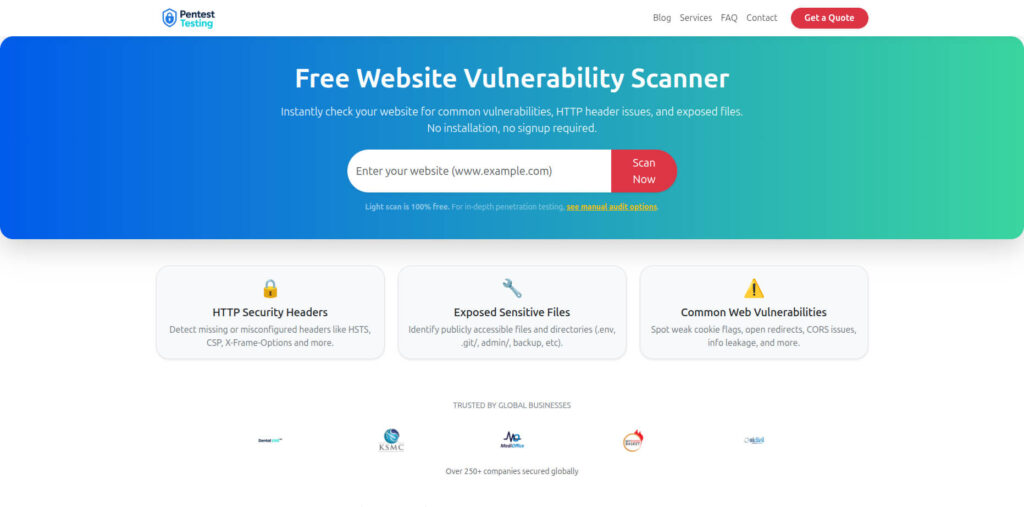
Where the free Website Vulnerability Scanner fits:
- Baseline internet-facing payment endpoints and supporting apps
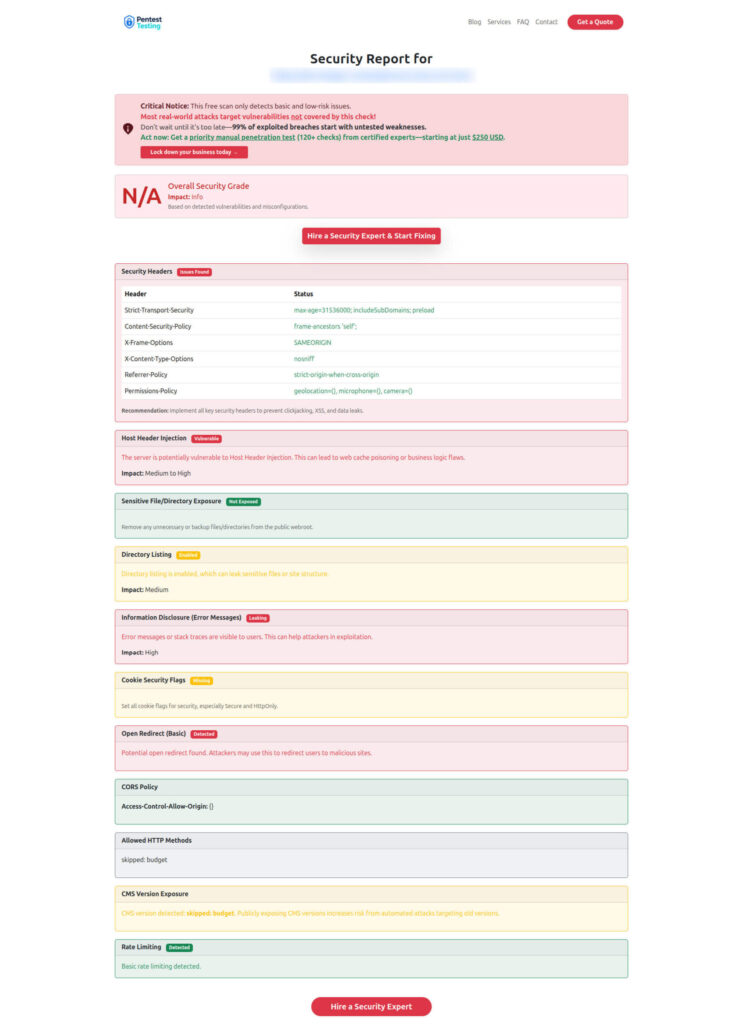
- Track improvements after remediation (before/after reports)
- Attach exported reports into the same evidence pack as your MFA snapshots
Free Website Vulnerability Scanner dashboard from Pentest Testing Corp
Sample assessment report by the free scanner to check Website Vulnerability
Use the tool here: https://free.pentesttesting.com/
Services: We make it assessor-friendly (and engineering-friendly)
If you want an end-to-end, audit-ready implementation (policy, gates, evidence packaging, and validation):
- Validate CDE entrypoints with testing:
- API Penetration Testing: https://www.cybersrely.com/api-penetration-testing-services/
- Web App Penetration Testing: https://www.cybersrely.com/web-application-penetration-testing/
- Full catalog: https://www.cybersrely.com/cybersecurity-services/
- Close gaps fast with programs:
- Risk Assessment Services: https://www.pentesttesting.com/risk-assessment-services/
- Remediation Services: https://www.pentesttesting.com/remediation-services/
Related Cyber Rely posts (recent)
- https://www.cybersrely.com/pci-dss-4-0-1-remediation-patterns/
- https://www.cybersrely.com/ci-gates-for-api-security/
- https://www.cybersrely.com/secrets-as-code-patterns/
- https://www.cybersrely.com/security-chaos-experiments-for-ci-cd/
- https://www.cybersrely.com/software-supply-chain-security-tactics/
- https://www.cybersrely.com/master-data-classification-as-code/
- https://www.cybersrely.com/feature-flags-as-evidence-win-audits/
🔐 Frequently Asked Questions (FAQs)
Find answers to commonly asked questions about PCI DSS 4.0.1 MFA.