7 Powerful CISA KEV Engineering Workflow Steps for 24–72h Lane
Engineering teams don’t lose sleep over “high CVSS” in the abstract—they lose sleep over actively exploited vulnerabilities landing in their stack while releases keep shipping.
That’s exactly why a CISA KEV engineering workflow is so effective: it turns “exploited in the wild” into a 24–72 hour exploited-vuln lane with clear ownership, merge-blocking controls, canary verification, and evidence that leadership (and auditors) can actually trust.
This post is a reference implementation you can copy, adapt, and ship.

If your team uses Microsoft 365 or Google Workspace, don’t miss our latest engineering playbook on OAuth abuse and consent phishing—covering allowlists, admin consent workflows, detection signals, and a token revocation runbook: https://www.cybersrely.com/oauth-abuse-consent-phishing-playbook/
What KEV is (and what it is not)
KEV (Known Exploited Vulnerabilities) is a curated signal: these vulnerabilities are being exploited. It’s not a replacement for severity scoring (CVSS), and it’s not a complete inventory of everything dangerous. It’s a high-confidence “act now” feed.
What KEV is great for
- Triggering a fast lane for exploited vulns across apps, infra, endpoints, and browsers
- Aligning engineering, security, and ops on one shared “must-fix now” queue
- Proving you act on real exploitation—not just theoretical risk
What KEV is not
- A full vulnerability management program
- A substitute for asset inventory / SBOM / dependency hygiene
- A guarantee that non-KEV vulns are safe to ignore
Why KEV beats CVSS-only prioritization
CVSS is useful, but it often fails you in practice:
- Exploitability changes faster than scoring
- Your environment matters (exposure, auth, compensating controls)
- “Critical” doesn’t always mean “reachable”
KEV gives you a simple rule: when exploitation is confirmed, your workflow must accelerate.
The reference workflow (end-to-end)
Here’s the pipeline you’re building:
KEV ingestion → normalize → match to assets/repos → ticket + SLA lane
→ PR gates (merge blocking) → canary + verification → release evidence bundle
You’re not just patching—you’re building a repeatable CISA KEV engineering workflow that produces proof.
Step 1) Ingest KEV on a schedule (without hardcoding external links)
Create a small ingestion job that pulls the KEV JSON feed via configuration, stores it, and detects new or changed items.
kev_ingest.py (Python, minimal + real-time friendly)
import os
import json
import time
import hashlib
from datetime import datetime, timezone
from urllib.request import urlopen, Request

KEV_FEED_URL = os.environ["KEV_FEED_URL"]  # set in CI/CD secrets (do not hardcode)
STATE_FILE = os.environ.get("KEV_STATE_FILE", ".kev_state.json")

def sha256_text(s: str) -> str:
    return hashlib.sha256(s.encode("utf-8")).hexdigest()

def fetch_json(url: str) -> dict:
    req = Request(url, headers={"User-Agent": "kev-lane/1.0"})
    with urlopen(req, timeout=30) as r:
        return json.loads(r.read().decode("utf-8"))

def load_state() -> dict:
    if not os.path.exists(STATE_FILE):
        return {"last_hash": None, "last_run": None}
    with open(STATE_FILE, "r", encoding="utf-8") as f:
        return json.load(f)

def save_state(state: dict) -> None:
    with open(STATE_FILE, "w", encoding="utf-8") as f:
        json.dump(state, f, indent=2)

def main():
    state = load_state()
    feed = fetch_json(KEV_FEED_URL)

    # Normalize a stable hash. If feed order changes, sort by CVE ID.
    vulns = feed.get("vulnerabilities", [])
    vulns_sorted = sorted(vulns, key=lambda v: v.get("cveID", ""))

    normalized = json.dumps(vulns_sorted, separators=(",", ":"), ensure_ascii=True)
    current_hash = sha256_text(normalized)

    changed = (current_hash != state.get("last_hash"))

    now = datetime.now(timezone.utc).isoformat()
    print(json.dumps({
        "changed": changed,
        "count": len(vulns_sorted),
        "run_at": now
    }))

    state["last_hash"] = current_hash
    state["last_run"] = now
    save_state(state)

    # Write a machine-friendly file for downstream steps
    with open("kev_vulns.json", "w", encoding="utf-8") as f:
        json.dump(vulns_sorted, f, indent=2)

    if not changed:
        print("No KEV changes detected. Exiting.")
        return

    print("KEV changed: downstream ticket + gate pipeline should run.")

if __name__ == "__main__":
    main()
Why this matters: you’re creating a predictable “KEV changed” signal that can trigger tickets, gates, and evidence—without turning everything into manual panic.
Step 2) Match KEV to your real assets (repos, services, endpoints)
KEV is only actionable if you can answer: “Where are we exposed?”
Start with two pragmatic mappings:
- Dependency / SBOM mapping (libraries + container packages)
- Product mapping (apps/services by tech + version)
A simple “asset routing” manifest
Create a small YAML file your platform team can own:
# kev_routing.yaml
routes:
  - match:
      vendorProject: "ExampleVendor"
      product: "ExampleGateway"
    owners:
      team: "platform"
      slack: "#platform-oncall"
    repos:
      - "org/gateway"
    lane: "24h"

  - match:
      cpeStartsWith: "cpe:2.3:a:example:examplelib"
    owners:
      team: "appsec"
      slack: "#appsec-triage"
    repos:
      - "org/api"
      - "org/web"
    lane: "48h"
Route KEV items into impacted repos
# kev_route.py
import json, yaml

with open("kev_vulns.json", "r", encoding="utf-8") as f:
    kev = json.load(f)

with open("kev_routing.yaml", "r", encoding="utf-8") as f:
    routing = yaml.safe_load(f)

def matches(rule, v):
    m = rule.get("match", {})
    vp = m.get("vendorProject")
    pr = m.get("product")
    cpe_prefix = m.get("cpeStartsWith")

    if vp and v.get("vendorProject") != vp:
        return False
    if pr and v.get("product") != pr:
        return False
    if cpe_prefix:
        cpes = v.get("cpes", []) or []
        if not any(str(c).startswith(cpe_prefix) for c in cpes):
            return False
    return True

hits = []
for v in kev:
    for r in routing["routes"]:
        if matches(r, v):
            hits.append({"cveID": v["cveID"], "route": r})

print(json.dumps({"matches": hits}, indent=2))
with open("kev_matches.json", "w", encoding="utf-8") as f:
    json.dump(hits, f, indent=2)
This is the first big unlock of a CISA KEV engineering workflow: KEV becomes routable work, not a scary spreadsheet.
Step 3) Create tickets automatically (with SLA lane labels)
You want one-click traceability:
- KEV item → ticket
- ticket → PR(s)
- PR(s) → pipeline evidence
- evidence → release approval
GitHub Issues example (works for many teams as a baseline)
# kev_to_github_issues.py
import os, json, requests

GITHUB_TOKEN = os.environ["GITHUB_TOKEN"]
REPO = os.environ["GITHUB_REPO"]  # e.g. "org/api"
API = "https://api.github.com"

def gh(method, path, **kwargs):
    headers = {
        "Authorization": f"Bearer {GITHUB_TOKEN}",
        "Accept": "application/vnd.github+json"
    }
    r = requests.request(method, f"{API}{path}", headers=headers, timeout=30, **kwargs)
    r.raise_for_status()
    return r.json()

with open("kev_matches.json", "r", encoding="utf-8") as f:
    matches = json.load(f)

for item in matches:
    cve = item["cveID"]
    lane = item["route"].get("lane", "72h")
    title = f"[KEV:{lane}] {cve} exploited-vuln lane"

    body = f"""## KEV exploited-vuln lane ticket

**CVE:** {cve}
**Lane:** {lane}
**Owner team:** {item['route']['owners']['team']}

### Required outcome
- Patch / mitigate and verify with canary
- Attach release evidence bundle
- Link merged PR(s)

### PR checklist (must be satisfied)
- [ ] PR references this issue
- [ ] KEV gate passes
- [ ] Canary verification attached
- [ ] Evidence bundle generated
"""
    labels = ["kev", f"kev-lane-{lane}"]

    gh("POST", f"/repos/{REPO}/issues", json={
        "title": title,
        "body": body,
        "labels": labels
    })
    print(f"Created issue for {cve} in {REPO}")
SLA lanes (recommended default)
- 24h: exposed internet-facing, auth bypass/RCE, common perimeter tech
- 48h: reachable in internal paths, high impact but constrained
- 72h: constrained exposure or mitigated quickly with compensating controls
Step 4) Enforce PR gates (merge-blocking) for KEV lane work
A KEV lane fails when teams “plan to patch” but still ship unrelated changes with known exploited risk outstanding.
Your gate rules should enforce behavior, not best intentions:
PR gate rules (practical + merge-blocking)
- Every KEV-lane PR must reference a KEV ticket ID
- The PR must include a mitigation declaration (what changed, how verified)
- The pipeline must run KEV-aware checks and emit artifacts
Add a “KEV fix declaration” file
# .security/kev_fix.yaml
ticket: "1234"
cve: "CVE-YYYY-NNNN"
component: "examplelib"
fixed_version: "1.2.3"
verification:
  - "canary_http_check"
  - "dependency_scan_pass"
release_evidence:
  required: true
CI check: block merge if declaration is missing/incomplete
#!/usr/bin/env bash
set -euo pipefail

FILE=".security/kev_fix.yaml"

if [[ ! -f "$FILE" ]]; then
  echo "Missing $FILE. KEV lane PRs must declare fix + verification."
  exit 1
fi

# Minimal validation without extra dependencies
grep -q "^ticket:" "$FILE" || { echo "Missing ticket:"; exit 1; }
grep -q "^cve:" "$FILE" || { echo "Missing cve:"; exit 1; }
grep -q "^fixed_version:" "$FILE" || { echo "Missing fixed_version:"; exit 1; }

echo "KEV fix declaration present."
GitHub Actions gate (reference pattern)
name: kev-exploited-vuln-lane-gate

on:
  pull_request:
    branches: [ "main" ]

jobs:
  kev_gate:
    runs-on: ubuntu-latest
    steps:
      - uses: actions/checkout@v4

      - name: KEV lane declaration check
      - run: |
          bash .security/check_kev_fix.sh

      - name: Run dependency scan (example)
        run: |
          echo "Run your SCA here (language-specific)."
          echo "Fail if the vulnerable version is still present."

      - name: Generate evidence stub
        run: |
          mkdir -p out/evidence
          echo "pr=${{ github.event.pull_request.number }}" > out/evidence/build.txt
          echo "sha=${{ github.sha }}" >> out/evidence/build.txt

      - name: Upload evidence
        uses: actions/upload-artifact@v4
        with:
          name: kev-evidence
          path: out/evidence
This is where your CISA KEV engineering workflow becomes real: you can’t merge KEV lane work without declaring, verifying, and exporting proof.
Step 5) Canary & verification design (endpoint, server, browser) + failure modes
Patching without verification is how teams accidentally “fix in staging” and ship nothing to reality.
A KEV lane should define at least one canary verification from each relevant layer:
A) Endpoint canary (app-level)
Expose a safe build metadata endpoint in staging/canary only:
// Express.js example (TypeScript)
import express from "express";
const app = express();

app.get("/__canary/build", (_req, res) => {
  res.json({
    git_sha: process.env.GIT_SHA,
    build_time: process.env.BUILD_TIME,
    kev_fix: process.env.KEV_FIX_ID, // e.g., "CVE-YYYY-NNNN"
  });
});

app.listen(3000);
Then verify it during canary:
import os, requests

CANARY_URL = os.environ["CANARY_URL"]
EXPECTED = os.environ["EXPECTED_KEV_FIX"]  # "CVE-YYYY-NNNN"

r = requests.get(f"{CANARY_URL}/__canary/build", timeout=10)
r.raise_for_status()
data = r.json()

assert data.get("kev_fix") == EXPECTED, f"Expected {EXPECTED}, got {data}"
print("Canary verification OK.")
B) Server canary (package/container level)
Verify the deployed artifact matches an approved digest:
#!/usr/bin/env bash
set -euo pipefail

DEPLOYED_DIGEST="$(cat deployed_digest.txt)"   # produced by deploy step
APPROVED_DIGEST="$(cat approved_digest.txt)"   # produced by build + signing step

if [[ "$DEPLOYED_DIGEST" != "$APPROVED_DIGEST" ]]; then
  echo "Digest mismatch: deployed != approved. Block release."
  exit 1
fi

echo "Digest verification OK."
C) Browser canary (fleet/version policy level)
For browser/endpoint KEVs, verification is usually policy + rollout confirmation, not an HTTP endpoint. Track:
- a canary ring (pilot group)
- version compliance in that ring
- rollout timeline and exceptions
You can represent verification as a signed JSON evidence record:
{
  "kev_fix": "CVE-YYYY-NNNN",
  "scope": "browser_fleet",
  "canary_ring": "pilot-5-percent",
  "verified_at": "2026-01-18T10:15:00Z",
  "result": "compliant",
  "notes": "Pilot ring updated; no policy blocks observed."
}
Common failure modes (design against them)
- Cached nodes: old pods/instances still serving traffic
- Partial rollouts: “some regions patched” but internet still hits old ones
- Shadow dependencies: transitive packages still vulnerable
- Rollback drift: emergency rollback reintroduces exploited versions
- Config-only mitigations: mitigations removed silently in later PRs
Your canary tests should be built to catch at least one of these failure modes.
Step 6) Evidence artifacts (what leadership and auditors actually want)
A KEV lane is only “done” when you can prove it—quickly—without Slack archaeology.
Evidence bundle: minimal but complete
Create a folder like:
out/evidence/
  kev_ticket.txt
  pr_links.txt
  build_sha.txt
  sca_results.json
  canary_verification.json
  deployment_digest.txt
  release_summary.md
Generate an evidence summary automatically
import json, os
from datetime import datetime, timezone

def read(path, default=""):
    return open(path, "r", encoding="utf-8").read().strip() if os.path.exists(path) else default

summary = {
  "generated_at": datetime.now(timezone.utc).isoformat(),
  "kev_ticket": read("out/evidence/kev_ticket.txt"),
  "build_sha": read("out/evidence/build_sha.txt"),
  "deployment_digest": read("out/evidence/deployment_digest.txt"),
  "canary_verification": json.loads(read("out/evidence/canary_verification.json", "{}")),
  "notes": read("out/evidence/notes.txt")
}

with open("out/evidence/evidence_bundle.json", "w", encoding="utf-8") as f:
    json.dump(summary, f, indent=2)

print("Evidence bundle generated.")
What reviewers should see in 30 seconds
- The KEV ticket, owner, and timestamps (SLA met)
- The merged PR(s) and the exact build SHA
- Canary verification output
- “Deployed digest == approved digest”
- Scans/tests ran and passed (or documented mitigations if no patch exists)
That’s the difference between “we patched” and “we can prove we patched.”
Step 7) Operationalize: metrics, escalation, and “no patch yet” paths
A mature CISA KEV engineering workflow also defines what happens when patching isn’t immediately available.
No patch yet (required path)
- apply compensating controls (WAF rules, feature disable, access restriction, isolation)
- add runtime detection (specific logs/alerts for exploit patterns)
- enforce expiry date on mitigation PRs (so temporary controls don’t become permanent myths)
- keep the KEV ticket open until patch verification is complete
Metrics worth tracking
- KEV MTTT (mean time to ticket)
- KEV MTTR (mean time to remediation/mitigation)
- % KEV items that shipped with complete evidence bundle
- Recurrence rate (reintroduced vulnerable versions)
Use our free scanner to validate external exposure
Even with strong internal gates, an outside-in check catches surprises: exposed admin panels, missing headers, risky endpoints, and misconfigurations that increase KEV blast radius.
“Free Website Vulnerability Scanner” by Pentest Testing Corp
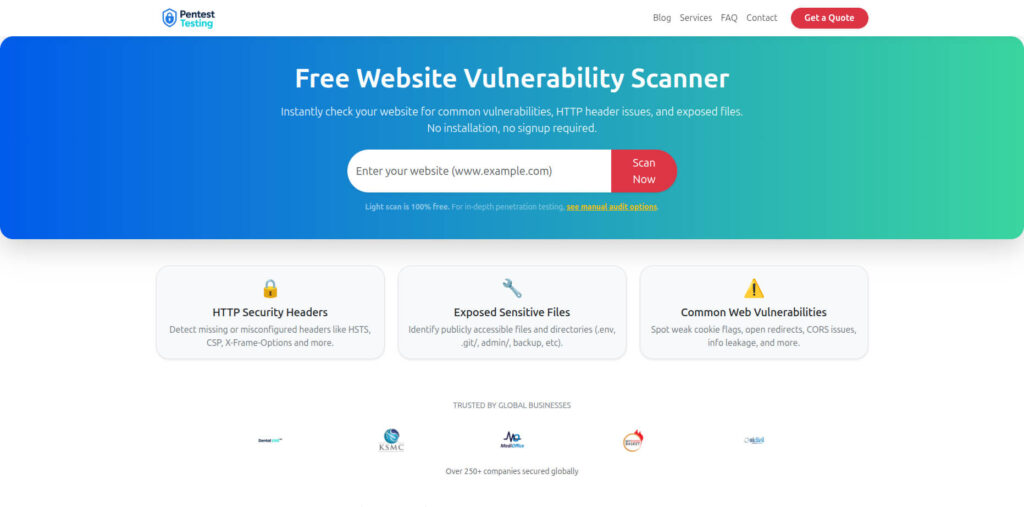
Sample vulnerability report to “check Website Vulnerability”
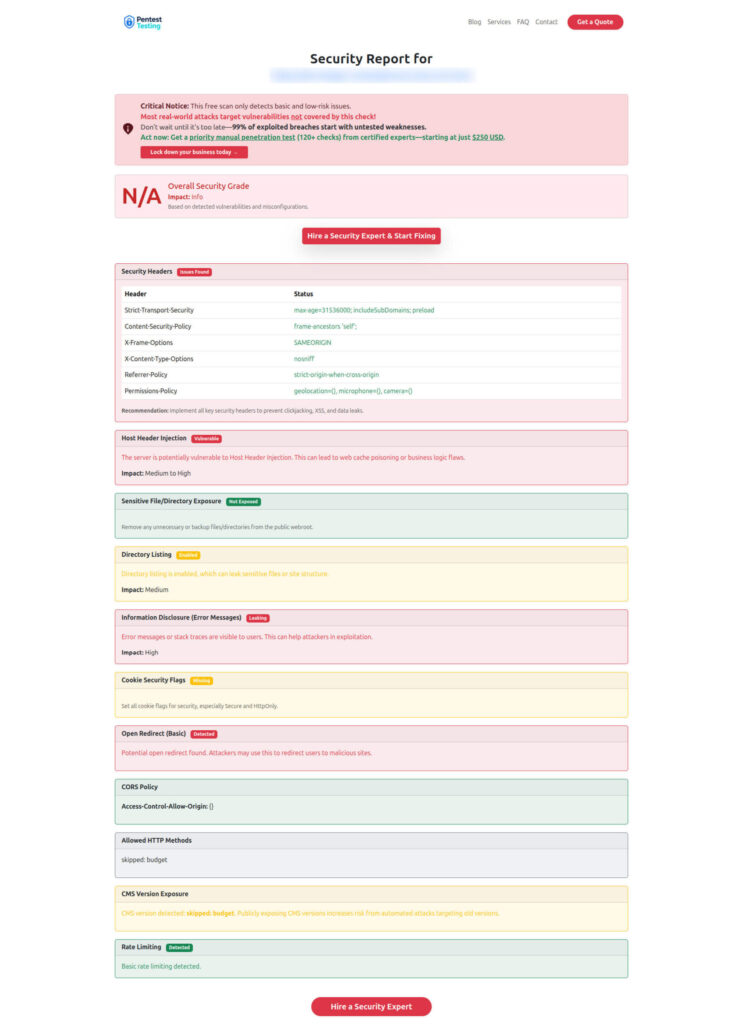
Tool link to include in the post: https://free.pentesttesting.com/
Related services/tools (Pentest Testing Corp)
- https://www.pentesttesting.com/risk-assessment-services/
- https://www.pentesttesting.com/remediation-services/
- https://free.pentesttesting.com/
Where these fit
- If you need a roadmap and control mapping: use Risk Assessment Services
- If you need engineering help closing findings fast: use Remediation Services
- If you need an outside-in baseline today: use the free scanner
Recommended recent Cyber Rely reads
If you’re building this exploited-vuln lane, these posts help you harden adjacent systems without slowing delivery:
- Gate CI with CISA KEV JSON: Ship Safer Builds — https://www.cybersrely.com/gate-ci-with-cisa-kev-json/
- 7 Proven Supply-Chain CI Hardening Wins (2026) — https://www.cybersrely.com/supply-chain-ci-hardening-2026/
- Add an ASVS 5.0 Gate to CI/CD: 7 Powerful Steps — https://www.cybersrely.com/asvs-5-0-gate-to-ci-cd/
- 6 Powerful Security Chaos Experiments for CI/CD — https://www.cybersrely.com/security-chaos-experiments-for-ci-cd/
- 9 Battle-Tested Non-Human Identity Security Controls — https://www.cybersrely.com/non-human-identity-security-controls/
- 7 Powerful Secure Web Push Patterns for Chrome 143 — https://www.cybersrely.com/secure-web-push-chrome-143/
🔐 Frequently Asked Questions (FAQs)
Find answers to commonly asked questions about the CISA KEV Engineering Workflow.