Author name: Zubayer A

7 Powerful Secure Observability Pipeline Controls

7 Powerful Secure Observability Pipeline Controls

7 Powerful Secure Observability Pipeline Controls (Trusted Logs, Traces & Metrics) Modern engineering teams built observability to answer: “Is the service up?”Security teams need observability to answer: “What happened, who did it, and can we prove it?” That gap is why secure observability matters. If your detection depends on telemetry, your telemetry becomes a security […]

7 Powerful Secure Observability Pipeline Controls Read More »
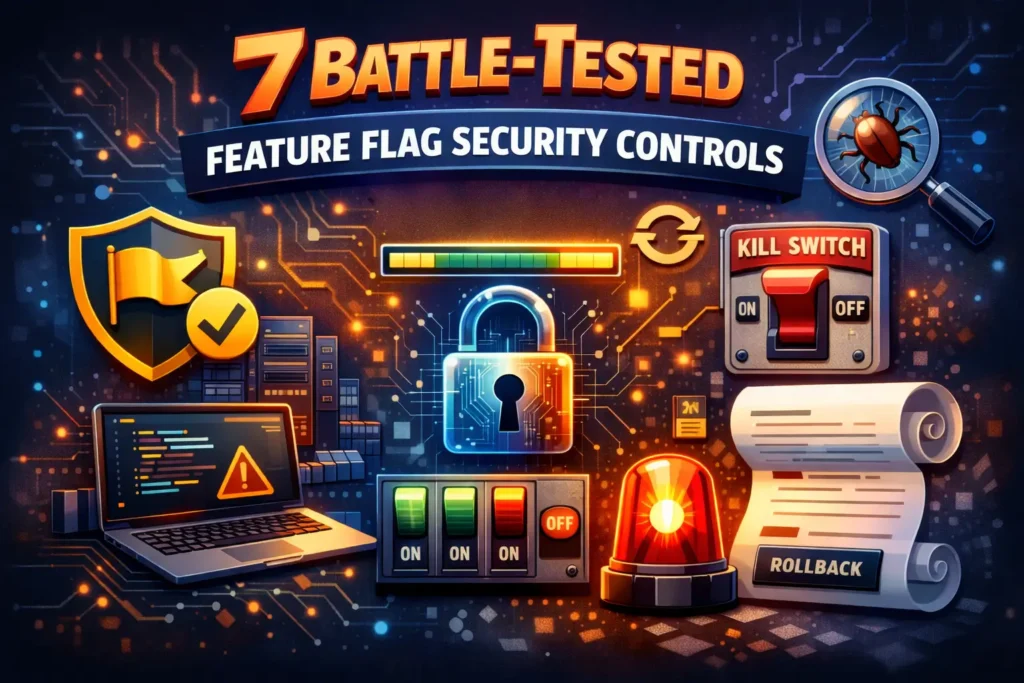
7 Battle-Tested Feature Flag Security Controls

7 Battle-Tested Feature Flag Security Controls

7 Battle-Tested Feature Flag Security Controls Securing Runtime Feature Configurations: Guarding Canary Releases, Flags & Rollouts Runtime feature configuration (feature flags, canary releases, progressive delivery, rollout tuning) is now a production control plane. It can enable admin-only behavior, change authorization flows, redirect traffic, relax validation, or widen access—without a code deploy. That’s why feature flag

7 Battle-Tested Feature Flag Security Controls Read More »

7 Powerful Ways Observability for Security Works

7 Powerful Ways Observability for Security Works

Elevating Observability to Security: Merging Metrics, Traces, and Threat Context Modern teams already have “observability”: dashboards, traces, uptime alerts, and plenty of logs. But when a real incident hits—account abuse, API key theft, privilege escalation, data export—you quickly learn an uncomfortable truth: Operational observability ≠ security insight. The good news: you don’t need a second

7 Powerful Ways Observability for Security Works Read More »

9 Powerful Secure Feature Flags to Stop Abuse

9 Powerful Secure Feature Flags to Stop Abuse

9 Powerful Secure Feature Flags to Stop Abuse Feature flags (aka flags in production) let teams ship faster: dark launches, gradual rollouts, experiments, kill switches, and decoupled deploys. But they also create a new security surface that rarely gets the same rigor as “normal” authz, config, or release engineering. In real incidents, feature flags fail

9 Powerful Secure Feature Flags to Stop Abuse Read More »

7 Unbreakable Cloud-Native Secrets Management Wins

7 Unbreakable Cloud-Native Secrets Management Wins

Secure Secrets in a Cloud-Native World: Beyond Vaults and Env Files Cloud-native teams don’t lose secrets because they don’t own a secrets manager. They lose secrets because credentials quietly spread across containers, CI/CD, logs, Helm values, build caches, and “temporary” debug paths—and nobody can answer, confidently: This guide is an engineering-first playbook for cloud-native secrets

7 Unbreakable Cloud-Native Secrets Management Wins Read More »

7 Proven Zero Trust Egress Controls for Microservices

7 Proven Zero Trust Egress Controls for Microservices

7 Proven Zero Trust Egress Controls for Microservices Egress is where “internal-only” systems quietly become internet-capable data movers. In modern microservices, a single compromised workload can: Zero Trust egress is how you reduce blast radius and make “service-to-service security” enforceable—without breaking delivery velocity. Secure Cloud-Native Secrets Management: Beyond Vaults & Env Files Practical patterns for

7 Proven Zero Trust Egress Controls for Microservices Read More »

7 Powerful Kev-To-Deploy Steps in 24–72h

7 Powerful Kev-To-Deploy Steps in 24–72h

7 Powerful Kev-To-Deploy Steps in 24–72h A practical “exploited-now” engineering pipeline (SolarWinds WHD + SmarterMail case snippets). When an exploited CVE hits your stack, “CVSS prioritization” is too slow and too fuzzy. Kev-To-Deploy is a separate engineering lane: a patch pipeline with strict clocks, clear ownership, safe rollout patterns, and hard proof that exploit paths

7 Powerful Kev-To-Deploy Steps in 24–72h Read More »

7 Powerful Fixes for Prompt Injection (Reprompt)

7 Powerful Fixes for Prompt Injection (Reprompt)

7 Powerful Fixes for Prompt Injection (Reprompt) A new class of prompt injection problems keeps surprising otherwise-solid engineering teams: parameter-to-prompt flows (often called “URL-to-prompt” or Reprompt) where a URL parameter like ?q= silently becomes an implicit instruction to an AI assistant. If your assistant auto-runs tools (search, retrieval, ticketing, email, CRM, code exec, cloud queries),

7 Powerful Fixes for Prompt Injection (Reprompt) Read More »

7 Powerful Forensics-Ready Telemetry Patterns

7 Powerful Forensics-Ready Telemetry Patterns

7 Powerful Forensics-Ready Telemetry Patterns Modern “observability” answers: Is the service up?Forensics-ready telemetry answers: Who did what, when, from where, using which identity, and what changed? Cyber Rely has already been publishing engineering-first, forensics-ready patterns across microservices, CI/CD, APIs, and SaaS logging—this post connects the dots into a concrete telemetry design you can ship. Just

7 Powerful Forensics-Ready Telemetry Patterns Read More »

7 Proven Patterns for Forensics-Ready Microservices

7 Proven Patterns for Forensics-Ready Microservices

7 Proven Patterns for Forensics-Ready Microservices If you’ve ever tried to investigate an incident in a microservices stack, you already know the pain: logs scattered across services, missing request IDs, inconsistent event formats, and “helpful” debug lines that omit the one thing you need—who did what, when, from where, and what changed. Forensics-ready microservices flip

7 Proven Patterns for Forensics-Ready Microservices Read More »