7 Proven Zero Trust Egress Controls for Microservices
Egress is where “internal-only” systems quietly become internet-capable data movers.
In modern microservices, a single compromised workload can:
- Call other internal services you never intended it to reach (east-west)
- Reach external endpoints for data exfiltration (north-south)
- Abuse cloud metadata endpoints, instance credentials, or over-scoped tokens
- Tunnel through “allowed” DNS/HTTPS paths that no one is monitoring
Zero Trust egress is how you reduce blast radius and make “service-to-service security” enforceable—without breaking delivery velocity.

1) Start with an “Egress Contract” (not a firewall rule)
Most teams jump straight to network policy and accidentally break DNS, package installs, or service discovery. Instead, define an egress contract per service:
- Who (workload identity) can call what (service/domain)
- How (mTLS, ports, methods)
- Why (ticket/control mapping)
- Evidence (logs + policy attestations)
Example: a simple egress contract in-repo:
# security/egress-contracts/payments-api.yaml
service: payments-api
identity:
  k8s_service_account: payments-api
allowed_internal:
  - to_service: orders-api
    namespace: prod
    ports: [443]
    protocol: https
  - to_service: ledger-db
    namespace: prod
    ports: [5432]
    protocol: tcp
allowed_external:
  - to_fqdn: "api.stripe.com"
    ports: [443]
    protocol: https
requirements:
  mtls: required
  authz_policy: required
  audit_logs: required
metadata:
  owner_team: payments
  change_ticket: SEC-4821
  review_interval_days: 90
This “contract” becomes the source for:
- K8s NetworkPolicy / CNI policy
- Service mesh authZ policy
- CI checks (policy-as-code)
- Runtime detection (baseline vs. allowed)
2) Enforce identity first: mTLS everywhere (mesh or not)
Zero Trust egress works best when the destination can verify who is calling (not just the source IP).
Option A: Service mesh mTLS (recommended)
Example (Istio-style) strict mTLS:
apiVersion: security.istio.io/v1beta1
kind: PeerAuthentication
metadata:
  name: default
  namespace: prod
spec:
  mtls:
    mode: STRICT
If you need exceptions (temporary), keep them explicit and time-bound:
apiVersion: security.istio.io/v1beta1
kind: PeerAuthentication
metadata:
  name: legacy-exception
  namespace: prod
spec:
  selector:
    matchLabels:
      app: legacy-worker
  mtls:
    mode: PERMISSIVE
Option B: App-level mTLS (when you can’t run a mesh)
Go HTTP server that requires client certs and checks identity metadata:
package main

import (
  "crypto/tls"
  "crypto/x509"
  "log"
  "net/http"
  "os"
)

func main() {
  caPEM, _ := os.ReadFile("/etc/tls/ca.pem")
  caPool := x509.NewCertPool()
  caPool.AppendCertsFromPEM(caPEM)

  tlsCfg := &tls.Config{
    ClientAuth: tls.RequireAndVerifyClientCert,
    ClientCAs:  caPool,
    MinVersion: tls.VersionTLS12,
    VerifyPeerCertificate: func(rawCerts [][]byte, _ [][]*x509.Certificate) error {
      cert, err := x509.ParseCertificate(rawCerts[0])
      if err != nil { return err }

      // Example: enforce a SAN pattern (adjust to your PKI/SPIFFE scheme)
      ok := false
      for _, uri := range cert.URIs {
        if uri.String() == "spiffe://prod/ns/prod/sa/payments-api" {
          ok = true
          break
        }
      }
      if !ok { return tls.AlertError(46) } // "certificate unknown" style failure
      return nil
    },
  }

  srv := &http.Server{
    Addr:      ":8443",
    TLSConfig: tlsCfg,
    Handler:   http.HandlerFunc(func(w http.ResponseWriter, r *http.Request) {
      w.WriteHeader(200); w.Write([]byte("ok"))
    }),
  }

  log.Fatal(srv.ListenAndServeTLS("/etc/tls/server.pem", "/etc/tls/server.key"))
}
3) Apply Zero Trust principles to service-to-service egress
A) Deny-by-default egress at the network layer
Kubernetes NetworkPolicy baseline (block everything unless allowed):
apiVersion: networking.k8s.io/v1
kind: NetworkPolicy
metadata:
  name: payments-egress-deny-all
  namespace: prod
spec:
  podSelector:
    matchLabels:
      app: payments-api
  policyTypes: ["Egress"]
  egress: []
Then add only required egress. Example: allow DNS to kube-dns and HTTPS to a known internal namespace label:
apiVersion: networking.k8s.io/v1
kind: NetworkPolicy
metadata:
  name: payments-egress-allow-dns-and-internal
  namespace: prod
spec:
  podSelector:
    matchLabels:
      app: payments-api
  policyTypes: ["Egress"]
  egress:
    - to:
        - namespaceSelector:
            matchLabels:
              kubernetes.io/metadata.name: kube-system
          podSelector:
            matchLabels:
              k8s-app: kube-dns
      ports:
        - protocol: UDP
          port: 53
        - protocol: TCP
          port: 53
    - to:
        - namespaceSelector:
            matchLabels:
              kubernetes.io/metadata.name: prod
          podSelector:
            matchLabels:
              app: orders-api
      ports:
        - protocol: TCP
          port: 443
Note: “FQDN allowlists” are CNI-specific (some CNIs support it; native NetworkPolicy doesn’t). If you need domain-based Zero Trust egress, standardize on a CNI that enforces it, and treat that as a platform control.
B) Add identity-aware authorization at L7 (service mesh / gateway)
Example (Istio-style) allow only a specific service account to call a destination:
apiVersion: security.istio.io/v1beta1
kind: AuthorizationPolicy
metadata:
  name: orders-allow-only-payments
  namespace: prod
spec:
  selector:
    matchLabels:
      app: orders-api
  action: ALLOW
  rules:
    - from:
        - source:
            principals:
              - "cluster.local/ns/prod/sa/payments-api"
      to:
        - operation:
            ports: ["443"]
            methods: ["GET","POST"]
This is the big leap: network egress controls + identity metadata enforcement.
4) Policy attestations: make egress rules auditable and reviewable
When a breach happens, you want proof that:
- the policy existed,
- was reviewed,
- and was actually enforced at runtime.
A) OPA/Rego policy for “egress contract” enforcement in CI
Example Rego rule: every workload with app label must have an egress contract file:
package egress.guardrails

deny[msg] {
  input.kind == "Deployment"
  ns := input.metadata.namespace
  app := input.spec.template.metadata.labels.app
  not contract_exists(ns, app)
  msg := sprintf("missing egress contract for %s/%s", [ns, app])
}

contract_exists(ns, app) {
  # Your CI loads a data document listing contract files
  some i
  data.contracts[i].namespace == ns
  data.contracts[i].app == app
}
In CI, run policy tests against PRs (example GitHub Actions):
name: policy-checks
on: [pull_request]
jobs:
  opa:
    runs-on: ubuntu-latest
    steps:
      - uses: actions/checkout@v4
      - name: Run OPA checks
        run: |
          opa test policy/ -v
          opa eval -i k8s/manifests/deployments.json -d policy/ "data.egress.guardrails.deny"
B) Runtime enforcement pipeline (RBAC + ABAC)
Treat enforcement like a pipeline:
- RBAC: who can change policies
- ABAC: what a service can reach based on labels/identity
- Attestation: store policy hashes + approvals
Minimal “policy hash” stamping (store in annotations):
metadata:
  annotations:
    security.cyberrely.com/egress-contract: "payments-api.yaml"
    security.cyberrely.com/policy-sha256: "9f6c...e21a"
    security.cyberrely.com/approved-by: "platform-security"
5) Build runtime guardrails that don’t break delivery
The practical trick: progressive enforcement.
Phase 1: Observe-only (log every egress)
If you run Envoy/service mesh, standardize egress access logs:
accessLogFormat: |
  ts=%START_TIME% src=%DOWNSTREAM_PEER_URI_SAN% dst=%UPSTREAM_CLUSTER%
  method=%REQ(:METHOD)% path=%REQ(X-ENVOY-ORIGINAL-PATH?:PATH)%
  status=%RESPONSE_CODE% bytes=%BYTES_SENT% trace=%REQ(X-REQUEST-ID)%
Phase 2: Soft-block (alert + allow)
Create a “default allow but alert on unknown” baseline job:
# tools/egress_baseline_watch.py
import json, sys
from collections import Counter

ALLOWED = {
  ("payments-api", "orders-api"),
  ("payments-api", "ledger-db"),
}

c = Counter()
for line in sys.stdin:
  ev = json.loads(line)
  pair = (ev["src_service"], ev["dst_service"])
  if pair not in ALLOWED:
    c[pair] += 1

for pair, n in c.most_common(20):
  print(f"ALERT: unexpected egress {pair} count={n}")
Phase 3: Hard-block (deny)
Once baselines stabilize, flip to deny-by-default at network + L7.
This is how you keep Zero Trust egress from turning into a productivity tax.
6) Observability for egress: “forensics-ready” by design
If investigations matter, log egress with the same discipline you’d apply to APIs and CI/CD evidence. Cyber Rely’s forensics-ready telemetry and microservices patterns translate directly to egress visibility: consistent fields, correlation IDs, and identity attribution. (Cyber Rely)
Minimum egress event schema (copy/paste)
{
  "ts": "2026-02-15T10:12:01Z",
  "event": "egress.connect",
  "src_service": "payments-api",
  "src_namespace": "prod",
  "src_identity": "cluster.local/ns/prod/sa/payments-api",
  "dst_type": "service",
  "dst_name": "orders-api",
  "dst_namespace": "prod",
  "dst_port": 443,
  "protocol": "https",
  "decision": "allow",
  "policy_id": "orders-allow-only-payments",
  "trace_id": "b2f3...",
  "request_id": "7a1d..."
}
OpenTelemetry: attach identity + destination attributes
# example: add semantic-ish attributes to spans
span.set_attribute("egress.dst.service", "orders-api")
span.set_attribute("egress.dst.namespace", "prod")
span.set_attribute("egress.protocol", "https")
span.set_attribute("egress.policy_id", "orders-allow-only-payments")
span.set_attribute("src.identity", "cluster.local/ns/prod/sa/payments-api")
7) Response playbook: when egress anomalies occur
When your detections fire, speed matters. Use a tight, engineering-friendly playbook:
A) Triage (10–20 minutes)
- Identify source identity (service account / workload)
- Identify destination (service/domain/IP)
- Confirm whether it violates the egress contract
B) Contain (fastest safe block)
Block by identity at L7 if possible (service mesh), otherwise block at egress gateway/CNI.
Example: quarantine a compromised workload via label + NetworkPolicy:
kubectl label pod -n prod -l app=payments-api quarantine=true --overwriteapiVersion: networking.k8s.io/v1
kind: NetworkPolicy
metadata:
name: quarantine-deny-egress
namespace: prod
spec:
podSelector:
matchLabels:
quarantine: "true"
policyTypes: ["Egress"]
egress: []C) Rotate + revoke (stop token reuse)
- Rotate service credentials/certs
- Revoke overly-broad tokens
- Re-issue least-privileged identity bindings
For deeper incident work (timeline + scope + containment validation), route to DFIR.
👉 If you need help validating impact and building a defensible timeline, see: Digital Forensic Analysis Services (DFIR).
Engineering integration checklist (CI/CD, K8s, gateways)
Use this as a delivery-safe rollout list:
- Each service has an egress contract file in-repo
- Deny-by-default egress at the cluster layer (namespace/app scoped)
- mTLS enforced (mesh strict, or app-level cert verification)
- L7 authZ policies reference service identity, not IPs
- Policy-as-code runs in CI (OPA/Gatekeeper/Kyverno style)
- Every egress decision is logged with identity + policy ID + trace/request IDs
- “Observe-only → soft-block → hard-block” rollout plan exists per namespace
- Break-glass procedure is time-bound and auditable
- Response playbook tested (tabletop + chaos-style drills)
If you want a fast, practical assessment of where your architecture is over-exposed (including service-to-service paths, egress weak points, and governance gaps), start here:
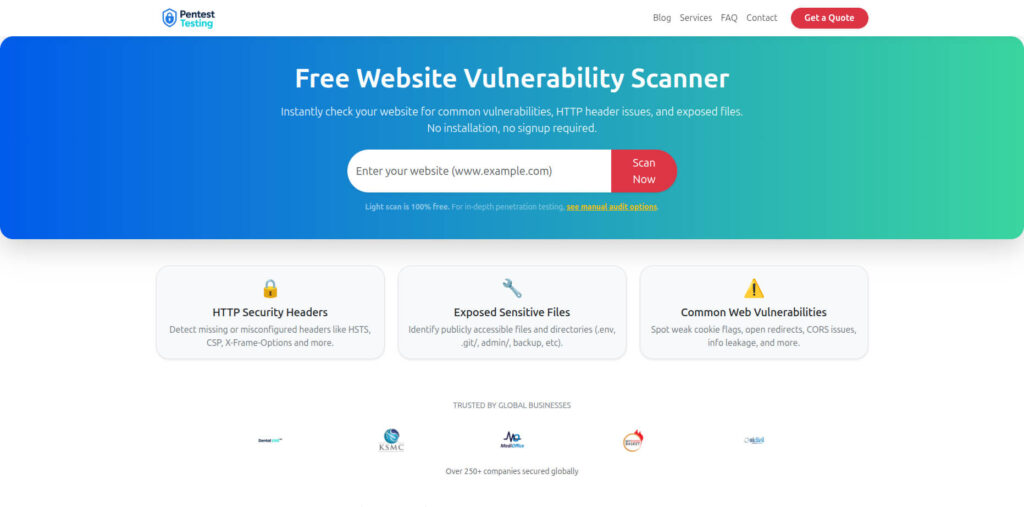
Free Website Vulnerability Scanner by (Pentest Testing Corp)
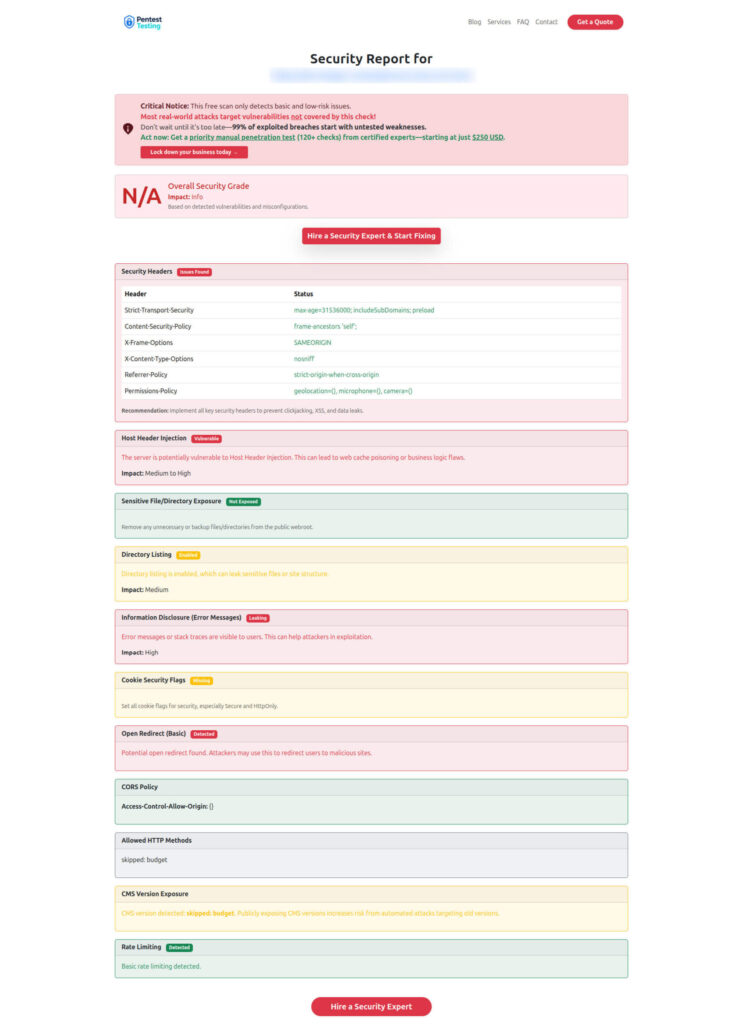
Sample report to check Website Vulnerability (from the tool)
Related reading on Cyber Rely (recent posts)
- 7 Powerful Forensics-Ready Telemetry Patterns
- 7 Proven Patterns for Forensics-Ready Microservices
- 7 Proven Forensics-Ready CI/CD Pipeline Steps
- 9 Battle-Tested Non-Human Identity Security Controls
- 7 Powerful Kev-To-Deploy Steps in 24–72h
🔐 Frequently Asked Questions (FAQs)
Find answers to commonly asked questions about Zero Trust Egress Controls for Microservices.