7 Proven Patterns for Forensics-Ready Microservices
If you’ve ever tried to investigate an incident in a microservices stack, you already know the pain: logs scattered across services, missing request IDs, inconsistent event formats, and “helpful” debug lines that omit the one thing you need—who did what, when, from where, and what changed.
Forensics-ready microservices flip that story. They’re designed so your engineering and security teams can reconstruct timelines fast, confidently scope impact, and answer leadership questions with evidence—not guesswork.
This guide is implementation-heavy. You’ll leave with copy/paste patterns for:
- structured + correlated logging
- request tracing and context propagation
- immutable audit trails (append-only + tamper resistance)
- CI/CD provenance + artifact capture
- hardening choices that make investigations efficient instead of reactive

New: Forensics-Ready Telemetry (Engineering Observability for IR)
Design telemetry that actually supports incident response—structured logs, trace correlation, audit events, and microservices context propagation.
Read now: https://www.cybersrely.com/forensics-ready-telemetry/
What “forensics-ready microservices” actually means
Forensics-ready microservices produce investigation-friendly telemetry by default:
- Consistent, structured logs (not freestyle strings)
- Correlation everywhere (request_id + trace_id across hops)
- High-value audit events (auth, access, export, admin actions, data changes)
- Immutability / trust (append-only + retention + tamper resistance)
- Provenance (what code/build ran, who shipped it, what artifacts existed)
If your system can’t answer these quickly, it’s not forensics-ready:
- Which user/session/API key triggered the first suspicious action?
- Which services were touched downstream (and in what order)?
- What resources were accessed/changed (before/after)?
- What build version was deployed at that time?
- What evidence do we have that logs weren’t altered?
Pattern 1) Adopt a canonical security event schema (don’t freestyle)
The fastest way to lose days in incident response is to let every service log a different “shape.”
Start with a canonical audit/security event and version it. Your goal: any engineer can grep/query across services and get consistent fields.
Canonical audit event (JSON)
{
  "schema": "audit.v1",
  "ts": "2026-02-03T10:15:23.412Z",
  "service": "orders-api",
  "env": "prod",
  "event": "order.export",
  "severity": "info",
  "result": "success",
  "actor": {
    "type": "user",
    "id": "u_12345",
    "role": "admin",
    "ip": "203.0.113.10",
    "ua": "Mozilla/5.0",
    "mfa": true
  },
  "target": {
    "type": "order",
    "id": "ord_8891",
    "tenant_id": "t_77"
  },
  "request": {
    "request_id": "req_01HR9K9YQ1K8PZ1WJ1Q8N2V7A1",
    "trace_id": "4bf92f3577b34da6a3ce929d0e0e4736",
    "span_id": "00f067aa0ba902b7",
    "method": "GET",
    "path": "/v1/orders/export",
    "status": 200
  },
  "change": {
    "fields": ["exported_at"],
    "before": null,
    "after": "2026-02-03T10:15:23.000Z"
  },
  "labels": {
    "region": "ap-south-1",
    "build_sha": "9c1a2f1",
    "release": "[email protected]"
  }
}
Minimal JSON Schema (versioned)
{
  "$id": "audit.v1.schema.json",
  "type": "object",
  "required": ["schema","ts","service","event","result","request","actor"],
  "properties": {
    "schema": { "const": "audit.v1" },
    "ts": { "type": "string" },
    "service": { "type": "string" },
    "event": { "type": "string" },
    "result": { "enum": ["success","fail","deny"] },
    "request": {
      "type": "object",
      "required": ["request_id"],
      "properties": {
        "request_id": { "type": "string" },
        "trace_id": { "type": "string" }
      }
    }
  }
}
Tip: Treat this schema like an API contract. If a service can’t emit it, the service isn’t “incident-ready.”
Pattern 2) Make request correlation non-negotiable (request_id everywhere)
Forensics-ready microservices require a single correlation handle that survives every hop.
Node.js (Express) middleware: request_id + structured logs
import crypto from "crypto";

export function correlation(req, res, next) {
  const incoming = req.header("x-request-id");
  const requestId = incoming || `req_${crypto.randomUUID()}`;

  req.requestId = requestId;
  res.setHeader("x-request-id", requestId);

  // Optional: attach actor hints if available (never trust blindly)
  req.actor = {
    ip: req.ip,
    ua: req.get("user-agent"),
  };

  next();
}
Structured logger helper (JSON)
export function auditLog(event) {
  // Output JSON only (easy to parse, ship, and query)
  process.stdout.write(JSON.stringify(event) + "\n");
}
Usage in an endpoint
app.get("/v1/orders/export", async (req, res) => {
  // ... authz checks ...

  auditLog({
    schema: "audit.v1",
    ts: new Date().toISOString(),
    service: "orders-api",
    env: process.env.NODE_ENV,
    event: "order.export",
    result: "success",
    actor: { type: "user", id: req.user.id, role: req.user.role, ip: req.actor.ip, ua: req.actor.ua, mfa: !!req.user.mfa },
    target: { type: "order", id: "bulk", tenant_id: req.user.tenantId },
    request: { request_id: req.requestId, method: req.method, path: req.path, status: 200 },
    labels: { build_sha: process.env.BUILD_SHA, release: process.env.RELEASE }
  });

  res.json({ ok: true, request_id: req.requestId });
});
Pattern 3) Propagate trace context (so you can follow the blast radius)
Correlation is good. Distributed tracing is better—because it shows dependency chains.
HTTP: propagate traceparent and x-request-id
import fetch from "node-fetch";

export async function callBilling(req, payload) {
  const headers = {
    "content-type": "application/json",
    "x-request-id": req.requestId,
  };

  const tp = req.header("traceparent");
  if (tp) headers["traceparent"] = tp;

  return fetch(process.env.BILLING_URL + "/v1/charge", {
    method: "POST",
    headers,
    body: JSON.stringify(payload),
  });
}
gRPC (example): pass correlation via metadata
import { Metadata } from "@grpc/grpc-js";

export function grpcMeta(req) {
  const md = new Metadata();
  md.set("x-request-id", req.requestId);
  const tp = req.header("traceparent");
  if (tp) md.set("traceparent", tp);
  return md;
}
Add security tags to spans (investigation-friendly traces)
// Pseudocode: attach attributes to spans
span.setAttribute("enduser.id", req.user.id);
span.setAttribute("tenant.id", req.user.tenantId);
span.setAttribute("auth.method", req.user.authMethod);
span.setAttribute("security.event", "order.export");
Why it matters: during an incident, you want to see “request entered gateway → orders-api → billing → storage” in seconds.
Pattern 4) Build an append-only audit trail (logs aren’t enough)
Logs can be dropped, sampled, or delayed. For high-value actions, write audit events into an append-only datastore.
Postgres: audit table (append-only)
CREATE TABLE audit_events (
  id           BIGSERIAL PRIMARY KEY,
  ts           TIMESTAMPTZ NOT NULL DEFAULT now(),
  schema       TEXT NOT NULL,
  service      TEXT NOT NULL,
  event        TEXT NOT NULL,
  result       TEXT NOT NULL,
  tenant_id    TEXT,
  actor_id     TEXT,
  actor_type   TEXT,
  request_id   TEXT NOT NULL,
  trace_id     TEXT,
  payload      JSONB NOT NULL
);

-- Prevent UPDATE/DELETE (append-only)
CREATE OR REPLACE FUNCTION deny_mutations() RETURNS trigger AS $$
BEGIN
  RAISE EXCEPTION 'audit_events is append-only';
END;
$$ LANGUAGE plpgsql;

CREATE TRIGGER audit_events_no_update
BEFORE UPDATE OR DELETE ON audit_events
FOR EACH ROW EXECUTE FUNCTION deny_mutations();
Transactionally write audit events (so evidence matches reality)
BEGIN;

-- business change
UPDATE orders SET exported_at = now() WHERE tenant_id = $1;

-- audit event (same transaction)
INSERT INTO audit_events(schema, service, event, result, tenant_id, actor_id, actor_type, request_id, trace_id, payload)
VALUES (
  'audit.v1', 'orders-api', 'order.export', 'success', $1, $2, 'user', $3, $4, $5::jsonb
);

COMMIT;
Pattern 5) Add tamper resistance (so logs can be trusted)
“Immutable” usually means hard-to-change and easy-to-detect changes.
Hash chaining audit events (simple, effective)
import hashlib, json

def chain_hash(prev_hash: str, event: dict) -> str:
  body = json.dumps(event, sort_keys=True, separators=(",", ":")).encode()
  return hashlib.sha256(prev_hash.encode() + body).hexdigest()

# Store prev_hash + this_hash with each event (or per time window)
Object-lock retention for log archives (Terraform example)
resource "aws_s3_bucket" "audit_archive" {
  bucket = "prod-audit-archive"
}

resource "aws_s3_bucket_object_lock_configuration" "lock" {
  bucket = aws_s3_bucket.audit_archive.id

  rule {
    default_retention {
      mode = "COMPLIANCE"
      days = 90
    }
  }
}
Even if you don’t use this exact stack, the principle holds: make evidence durable.
Pattern 6) CI/CD provenance: capture “what shipped” as evidence
Forensics-ready microservices don’t stop at runtime telemetry. Investigations also need build identity:
- commit SHA
- build number
- SBOM / dependency snapshot
- signed artifacts (optional but powerful)
- deploy metadata (what cluster/namespace, when, by which pipeline)
GitHub Actions: retain evidence bundle
name: build-and-evidence
on: [push]

jobs:
  build:
    runs-on: ubuntu-latest
    steps:
      - uses: actions/checkout@v4

      - name: Set build metadata
        run: |
          echo "BUILD_SHA=$(git rev-parse --short HEAD)" >> $GITHUB_ENV
          echo "RELEASE=orders@$(date +%Y.%m.%d)-${GITHUB_RUN_NUMBER}" >> $GITHUB_ENV

      - name: Build
        run: |
          docker build -t orders:${{ env.BUILD_SHA }} .

      - name: Generate SBOM (example)
        run: |
          mkdir -p evidence
          echo "{\"release\":\"${{ env.RELEASE }}\",\"sha\":\"${{ env.BUILD_SHA }}\"}" > evidence/build.json
          # Replace with your SBOM tool of choice
          echo "sbom-placeholder" > evidence/sbom.txt

      - name: Upload evidence bundle
        uses: actions/upload-artifact@v4
        with:
          name: evidence-${{ env.RELEASE }}
          path: evidence/
          retention-days: 90
Deploy manifest: stamp build identity (so telemetry can link to “what ran”)
apiVersion: apps/v1
kind: Deployment
metadata:
  name: orders-api
spec:
  template:
    metadata:
      labels:
        app: orders-api
        release: "[email protected]"
        build_sha: "9c1a2f1"
    spec:
      containers:
        - name: orders-api
          image: orders:9c1a2f1
          env:
            - name: RELEASE
              value: "[email protected]"
            - name: BUILD_SHA
              value: "9c1a2f1"
Pattern 7) Hardening that makes investigations faster (not louder)
Some “security best practices” help prevention, but not investigation. Forensics-ready microservices prioritize both.
Practical hardening moves that help DFIR
- Service identity (mTLS or signed service tokens) so you can attribute service-to-service calls.
- Least privilege per service so you can scope blast radius quickly.
- Secrets hygiene + rotation evidence so you can prove what changed after containment.
- High-value event coverage (exports, admin actions, role changes, auth failures, token refresh, key creation).
- Redaction by default so you don’t turn logging off during the next incident.
Python redaction example (safe logging)
SENSITIVE_KEYS = {"password", "token", "secret", "authorization", "api_key"}

def redact(obj):
    if isinstance(obj, dict):
        return {k: ("[REDACTED]" if k.lower() in SENSITIVE_KEYS else redact(v)) for k, v in obj.items()}
    if isinstance(obj, list):
        return [redact(x) for x in obj]
    return obj
A “real-world” blueprint: telemetry pipeline for forensics-ready microservices
Use a simple mental model:
App logs (structured JSON) + audit events (append-only) + traces (context propagation) + CI/CD evidence (provenance)
→ shipped into a central place with retention + access controls.
Fluent Bit example: ship JSON logs reliably
[INPUT]
  Name   tail
  Path   /var/log/containers/*.log
  Parser json
  Tag    kube.*

[FILTER]
  Name   kubernetes
  Match  kube.*
  Merge_Log On

[OUTPUT]
  Name  http
  Match *
  Host  log-collector.internal
  Port  8080
  URI   /ingest
  Format json
Investigation queries you’ll actually use
Find suspicious actor activity across services (by request_id)
# Example: local export for triage
cat logs.jsonl | jq -c 'select(.request.request_id=="req_01HR9K9YQ1K8PZ1WJ1Q8N2V7A1")'
Filter for high-value events only
cat logs.jsonl | jq -c 'select(.schema=="audit.v1" and (.event|test("export|admin|role|token|login")))'Where the free scanner fits (fast signal before deeper work)
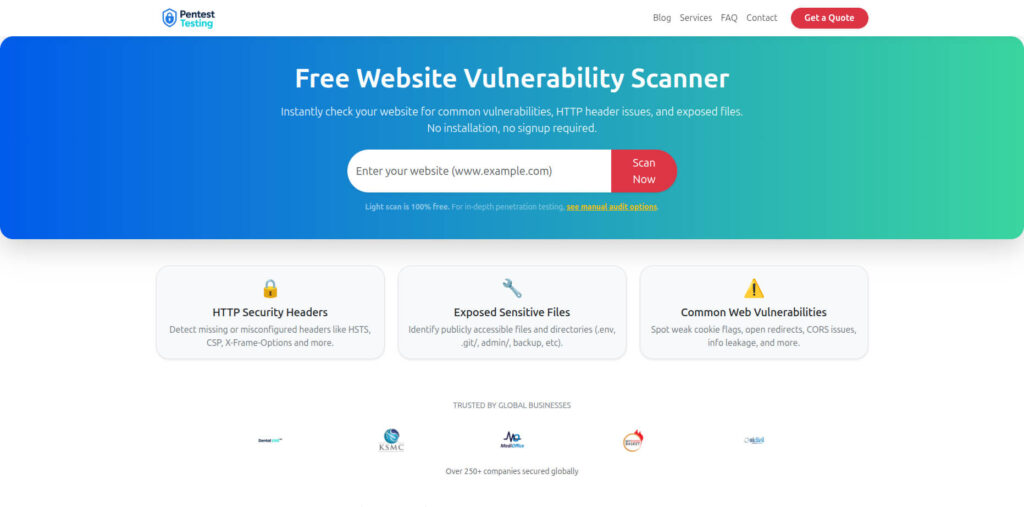
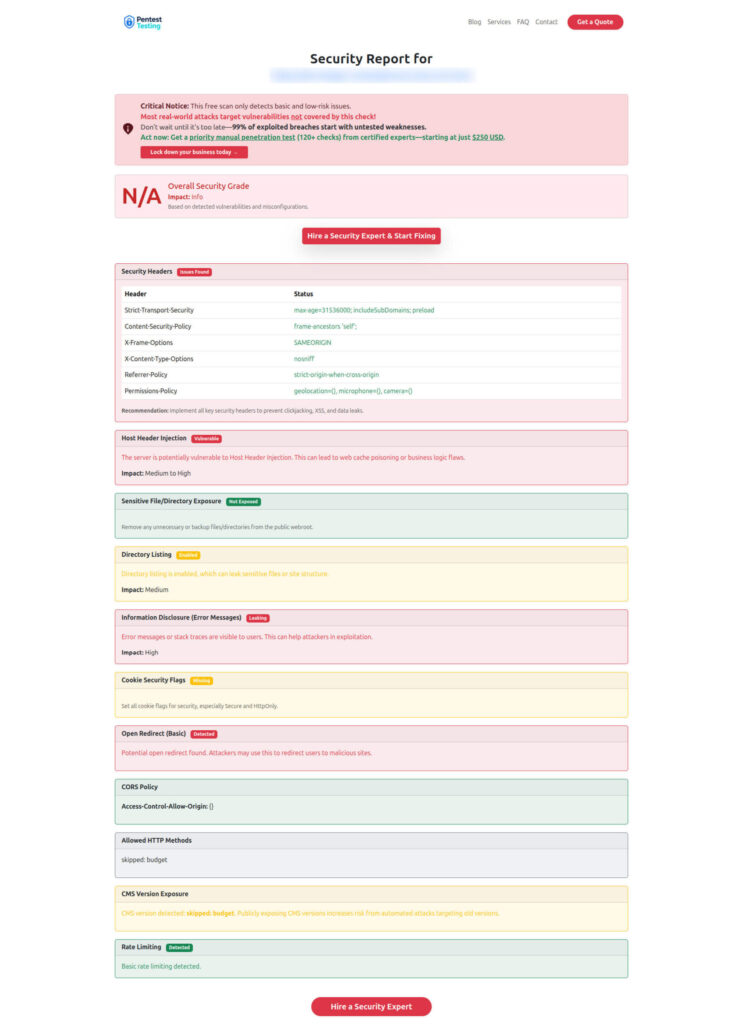
If you want a quick, practical starting point for risk discovery (especially for web apps and APIs), use our free tool:
Website Vulnerability Scanner: https://free.pentesttesting.com/
Our Free Website Vulnerability Scanner tool Dashboard
Sample report screenshot to check Website Vulnerability
Need help making your stack forensics-ready?
If you want an expert-led path—from risk discovery to remediation and incident-grade evidence—these services are a strong next step:
- Risk Assessment Services: https://www.pentesttesting.com/risk-assessment-services/
- Remediation Services: https://www.pentesttesting.com/remediation-services/
- Digital Forensic Analysis Services: https://www.pentesttesting.com/digital-forensic-analysis-services/
Related Cyber Rely reading (implementation-heavy)
If you’re building forensics-ready microservices, these companion guides go deeper on the building blocks:
- Forensics-Ready APIs for Microservices: https://www.cybersrely.com/forensics-ready-apis-microservices-observability/
- Forensics-Ready SaaS Logging Patterns: https://www.cybersrely.com/forensics-ready-saas-logging-audit-trails/
- Forensics-Ready CI/CD Pipeline Steps: https://www.cybersrely.com/forensics-ready-ci-cd-pipeline-steps/
- Supply-Chain CI Hardening Wins (2026): https://www.cybersrely.com/supply-chain-ci-hardening-2026/
- Security Chaos Experiments for CI/CD: https://www.cybersrely.com/security-chaos-experiments-for-ci-cd/
🔐 Frequently Asked Questions (FAQs)
Find answers to commonly asked questions about Forensics-Ready Microservices.