7 Powerful Kev-To-Deploy Steps in 24–72h
A practical “exploited-now” engineering pipeline (SolarWinds WHD + SmarterMail case snippets).
When an exploited CVE hits your stack, “CVSS prioritization” is too slow and too fuzzy. Kev-To-Deploy is a separate engineering lane: a patch pipeline with strict clocks, clear ownership, safe rollout patterns, and hard proof that exploit paths are blocked after deploy.
This post is dev-first and copy/paste-friendly: routing logic, exposure checks, canary release patterns, verification telemetry, and post-fix hardening—built for engineering leaders who need a repeatable exploited vulnerabilities process and measurable vulnerability SLAs.
New Blog:Engineering Zero Trust Egress: Service-to-Service Security Without Breaking Delivery
Read: https://www.cybersrely.com/zero-trust-egress-service-to-service-security/
Summary: Practical Zero Trust egress patterns for microservices—mTLS, identity-based policy enforcement, runtime guardrails, observability, and incident response.
Why “exploited in the wild” needs its own lane
In engineering vulnerability management, “high severity” and “actively exploited” are not the same problem.
- CVSS helps estimate impact.
- Exploited-now means attackers are already using it—and your priority becomes time-to-mitigation and time-to-verified-fix.
Kev-To-Deploy exists to prevent two failure modes:
- Backlog paralysis: “Next sprint.”
- Panic patching: “Hotfix now,” followed by zero verification and weak audit evidence.
A practical Kev-To-Deploy SLA (24–72h)
| Stage | Target | Output |
|---|---|---|
| Intake + scope | 0–2h | CVE ticket + “what could be affected” hypothesis |
| Ownership | 2–6h | Assigned team/service/repo owner + on-call buddy |
| Exposure check | 6–12h | Internet-facing proof + version proof + inventory gaps logged |
| Mitigate | ≤24h | Comp controls (WAF/ACL/config) + canary plan |
| Patch | ≤72h | Rollout complete + regression + telemetry evidence |
| Post-fix hardening | 3–7d | Secrets rotation + admin boundary checks + restore test |
1) Intake → ownership: map a KEV CVE to teams/services/repos fast
The fastest teams don’t “figure out ownership” during a fire. They codify routing.
Create a Kev-To-Deploy routing map (YAML)
# security/kev-to-deploy-routing.yaml
products:
  - match:
      vendor: "SolarWinds"
      product: "Web Help Desk"
    owners:
      team: "IT-Platform"
      escalation: "#it-platform-oncall"
      repos: ["infra/helpdesk", "ops/windows-services"]
      runbook: "runbooks/helpdesk.md"

  - match:
      vendor: "SmarterTools"
      product: "SmarterMail"
    owners:
      team: "Messaging"
      escalation: "#messaging-oncall"
      repos: ["infra/email", "ops/windows-baseline"]
      runbook: "runbooks/smartermail.md"
Enforce ownership in Git
# CODEOWNERS
/security/ @security-eng @platform-leads
/runbooks/ @security-eng @sre
Auto-open a “Kev-To-Deploy” ticket (Python skeleton)
This reads a KEV-like JSON from your internal mirror (file/artifact store) and routes it to owners.
import json
from dataclasses import dataclass
from typing import Any

KEV_JSON = "feeds/kev.json"

@dataclass
class Routed:
    cve: str
    vendor: str
    product: str
    team: str
    channel: str
    repos: list[str]

def load_kev() -> list[dict[str, Any]]:
    with open(KEV_JSON, "r", encoding="utf-8") as f:
        data = json.load(f)
    return data.get("vulnerabilities", data)

def route(v: dict[str, Any]) -> Routed:
    cve = v.get("cveID") or v.get("cve") or "UNKNOWN"
    vendor = (v.get("vendorProject") or v.get("vendor") or "").strip()
    product = (v.get("product") or "").strip()
    key = f"{vendor}::{product}".lower()

    if "solarwinds" in key and "web help desk" in key:
        return Routed(cve, vendor, product, "IT-Platform", "#it-platform-oncall",
                      ["infra/helpdesk", "ops/windows-services"])
    if "smartertools" in key and "smartermail" in key:
        return Routed(cve, vendor, product, "Messaging", "#messaging-oncall",
                      ["infra/email", "ops/windows-baseline"])

    return Routed(cve, vendor, product, "Security-Triage", "#security-triage", [])

def main():
    for v in load_kev():
        r = route(v)
        print(f"[Kev-To-Deploy] {r.cve} → {r.team} repos={r.repos} notify={r.channel}")

if __name__ == "__main__":
    main()
2) The “Exposure Check” playbook (internet-facing + inventory gaps + version proof)
Your job in the first 6–12 hours is evidence, not opinions:
- Is it internet-facing?
- Are we running a vulnerable version?
- What do we not know because inventory is incomplete?
(A) Internet-facing detection (cloud-first, safe-by-default)
AWS SGs: find 0.0.0.0/0 inbound
aws ec2 describe-security-groups --output json \
| jq '.SecurityGroups[]
  | {GroupId,GroupName,IpPermissions}
  | select(.IpPermissions[].IpRanges[].CidrIp?=="0.0.0.0/0")'
Kubernetes: find public LoadBalancers
kubectl get svc -A -o json \
| jq -r '.items[]
  | select(.spec.type=="LoadBalancer")
  | "\(.metadata.namespace)/\(.metadata.name) -> \(.status.loadBalancer.ingress // [])"'
(B) Version proof (make it auditable)
Windows: capture installed software evidence
New-Item -ItemType Directory -Force .\evidence | Out-Null
Get-ItemProperty "HKLM:\Software\Microsoft\Windows\CurrentVersion\Uninstall\*" |
  Select-Object DisplayName, DisplayVersion, Publisher |
  Sort-Object DisplayName |
  Out-File ".\evidence\installed_software.txt"
Containers: capture running images
mkdir -p evidence
kubectl get deploy -A -o json \
| jq -r '.items[]
  | .spec.template.spec.containers[]
  | "\(.name) \(.image)"' \
| tee evidence/running_images.txt
(C) Inventory gaps are defects (log them)
Drop this into the ticket as a checklist:
## Kev-To-Deploy Exposure Proof
- Internet-facing: YES / NO / UNKNOWN
- Entry points: DNS/LB/Ingress/WAF policies
- Instance count: N
- Version proof method: package/build/API
- Version observed: X
- Evidence artifact path: (build logs / CI artifacts / evidence folder)
- Inventory gaps found: (hosts missing, unmanaged DNS, unknown owner)
3) Patch/mitigate patterns: ship fast without breaking prod
Kev-To-Deploy favors safe speed:
- Mitigate quickly if patch isn’t instant
- Patch within 72 hours
- Verify with telemetry
(A) Canary rollout (Kubernetes / progressive delivery)
apiVersion: argoproj.io/v1alpha1
kind: Rollout
metadata:
  name: webhelpdesk
spec:
  replicas: 10
  strategy:
    canary:
      steps:
        - setWeight: 10
        - pause: {duration: 10m}
        - setWeight: 50
        - pause: {duration: 20m}
        - setWeight: 100
  selector:
    matchLabels: { app: webhelpdesk }
  template:
    metadata:
      labels: { app: webhelpdesk }
    spec:
      containers:
        - name: webhelpdesk
          image: your-registry/webhelpdesk:PATCHED_BUILD
(B) Compensating controls (WAF/ACL) with expiry metadata
Keep rules narrow and time-bound.
{
  "rule_name": "TEMP-Kev-To-Deploy-CVE-XXXX-YYYY",
  "action": "BLOCK",
  "scope": {
    "paths": ["/admin/*", "/api/internal/*"],
    "methods": ["POST"],
    "rate_limit_per_minute": 60
  },
  "metadata": {
    "expires_utc": "2026-02-14T00:00:00Z",
    "change_ticket": "SEC-1234",
    "owner": "security-eng"
  }
}
(C) Rapid config fixes (the 2-hour win)
Nginx: IP allowlist admin routes
location /admin/ {
  allow 10.0.0.0/8;
  allow 192.168.0.0/16;
  deny all;
  proxy_pass http://app_upstream;
}
4) Verification: regression tests + telemetry that proves the exploit path failed
Kev-To-Deploy requires proof, not “we think it’s fixed.”
(A) Add a Kev-To-Deploy CI evidence artifact
# .github/workflows/kev-to-deploy-evidence.yml
name: Kev-To-Deploy Evidence
on: [push]
jobs:
  verify:
    runs-on: ubuntu-latest
    steps:
      - uses: actions/checkout@v4
      - name: Run unit/regression tests
        run: |
          npm ci
          npm test
      - name: Generate verification evidence
        run: |
          mkdir -p evidence
          echo "{\"ts\":\"$(date -u +%FT%TZ)\",\"stage\":\"post-deploy-smoke\",\"result\":\"pass\"}" \
            >> evidence/kev_to_deploy.ndjson
      - name: Upload evidence artifact
        uses: actions/upload-artifact@v4
        with:
          name: kev-to-deploy-evidence
          path: evidence/
          retention-days: 90
(B) Add “blocked/failed attempt” telemetry queries (examples)
Splunk
index=waf earliest=-24h action=blocked
| stats count by rule, uri_path
| sort -count
Kusto-style
WAFLogs
| where TimeGenerated > ago(24h)
| where Action == "Blocked"
| summarize blocks=count() by RuleName, bin(TimeGenerated, 1h)
(C) Post-deploy smoke checks (safe)
curl -fsS https://YOUR_SERVICE/healthz >/dev/null
echo "healthz ok"
5) Case study snippets: Kev-To-Deploy for SolarWinds WHD + SmarterMail
These two patterns show why an exploited-now lane matters: edge-exposed admin surfaces + high-value server software.
Case A — SolarWinds Web Help Desk (WHD) unauth RCE (KEV)
Kev-To-Deploy playbook (first 12 hours):
- Find every instance (prod, DR, “forgotten test”)
- Prove exposure (DNS/LB/WAF; capture evidence)
- Prove version (installer/package evidence)
- If internet-facing: apply temporary ACL/WAF tightening and restrict admin routes until patched
- Patch with a canary rollout + verification telemetry
Why it’s tricky: help desk systems are often reachable by remote staff, vendors, and integrations—so “it’s internal” is frequently wrong.
Case B — SmarterMail unauth RCE (KEV)
Kev-To-Deploy playbook (first 24 hours):
- Restrict management surfaces to allowlisted networks
- Patch to the vendor-fixed build as part of a staged rollout
- Verify that exploit attempts are blocked/failed in WAF/app logs
- Add detection for suspicious auth-less access patterns and unusual process/network behavior on the host
Why it’s tricky: mail systems are high-value and often under-monitored, and attackers commonly pivot after initial compromise.
6) Post-fix hardening (don’t stop at “patched”)
Kev-To-Deploy ends with “verified fixed,” but strong teams add a short hardening sprint:
(A) Secrets rotation (targeted, not random)
Rotate secrets that could be exposed through the vulnerable surface:
- service accounts used by the affected app
- API keys for downstream integrations
- admin credentials and SMTP relays (for mail systems)
AWS Secrets Manager rotation trigger (CLI example)
aws secretsmanager rotate-secret --secret-id YOUR_SECRET_ID(B) Admin boundary checks
- move admin endpoints behind VPN / private ingress
- enforce strong MFA + device trust where possible
- deny-by-default network paths from the service to “crown jewel” subnets
(C) Backup/restore test (the confidence multiplier)
Run a real restore drill:
- restore to isolated environment
- verify integrity + boot + app-level checks
- document RTO/RPO reality vs assumptions
7) “Kev-To-Deploy” checklist you can paste into tickets
# Kev-To-Deploy (24–72h) Checklist

## Intake (0–2h)
- [ ] Create ticket (CVE, product, suspected assets)
- [ ] Set SLA clock + escalation channel

## Ownership (2–6h)
- [ ] Map to team/service/repo owners
- [ ] Assign incident buddy + reviewer

## Exposure Check (6–12h)
- [ ] Internet-facing proof captured
- [ ] Version proof captured
- [ ] Inventory gaps logged as defects

## Mitigate (≤24h)
- [ ] WAF/ACL/temp config controls (with expiry + ticket ref)
- [ ] Canary plan prepared

## Patch (≤72h)
- [ ] Patch deployed via staged rollout
- [ ] Regression tests passed
- [ ] Evidence artifacts uploaded

## Verify
- [ ] Telemetry shows attempts blocked/failed
- [ ] Post-deploy smoke checks complete

## Post-fix Hardening (3–7d)
- [ ] Secrets rotation complete
- [ ] Admin boundary tightened
- [ ] Backup/restore test performed
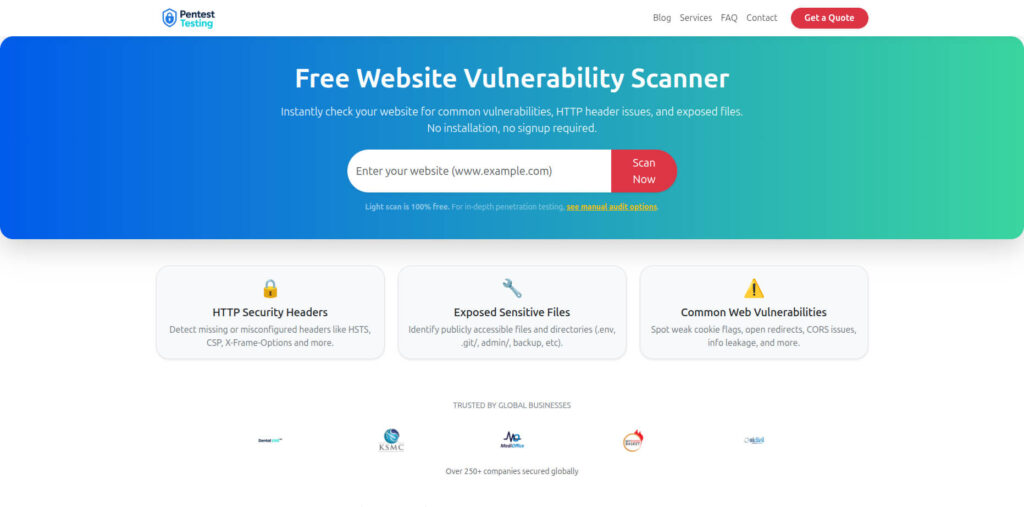
Free Website Vulnerability Scanner tool (dashboard)
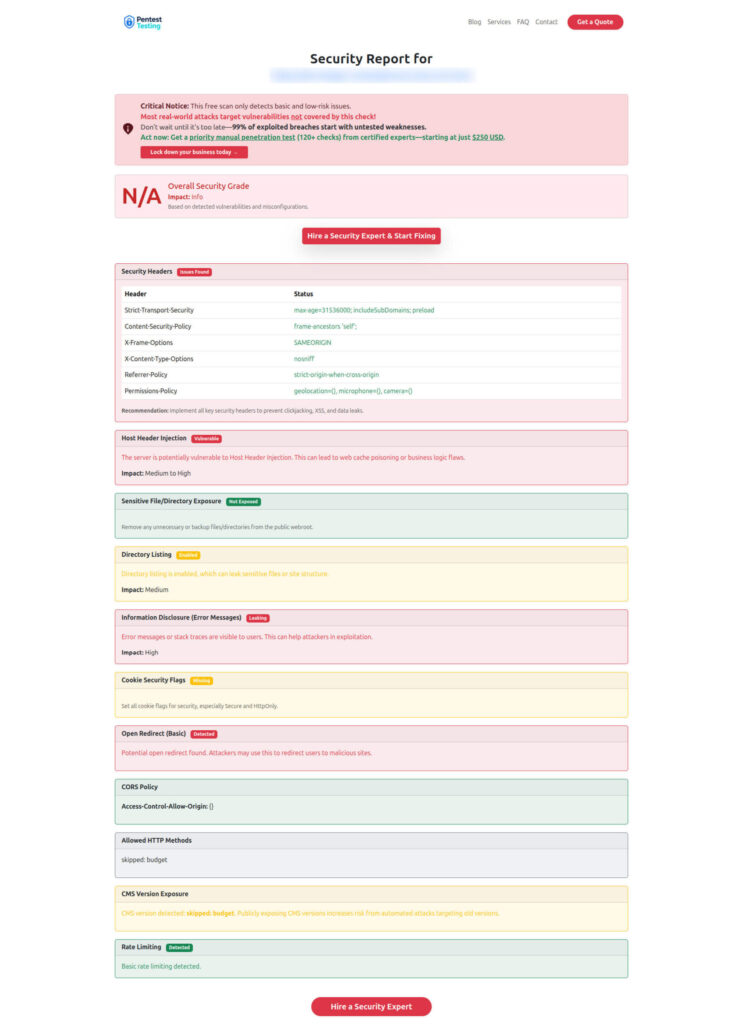
Sample report to check Website Vulnerability (from the tool)
Dedicated Service Pages
If you need third-party validation, evidence packaging, or an accelerated remediation plan:
- Risk Assessment Services: https://www.pentesttesting.com/risk-assessment-services/
- Remediation Services: https://www.pentesttesting.com/remediation-services/
- Digital Forensic Analysis / DFIR: https://www.pentesttesting.com/digital-forensic-analysis-services/
Related reading on Cyber Rely (internal)
- https://www.cybersrely.com/cisa-kev-engineering-workflow-exploited/
- https://www.cybersrely.com/forensics-ready-telemetry/
- https://www.cybersrely.com/forensics-ready-ci-cd-pipeline-steps/
- https://www.cybersrely.com/forensics-ready-microservices-design-patterns/
- https://www.cybersrely.com/reprompt-url-to-prompt-prompt-injection/
- https://www.cybersrely.com/passkeys-token-binding-stop-session-replay/
- https://www.cybersrely.com/oauth-abuse-consent-phishing-playbook/
🔐 Frequently Asked Questions (FAQs)
Find answers to commonly asked questions about Kev-To-Deploy Steps.