7 Proven Cisco AsyncOS Zero-Day Rebuild Patterns
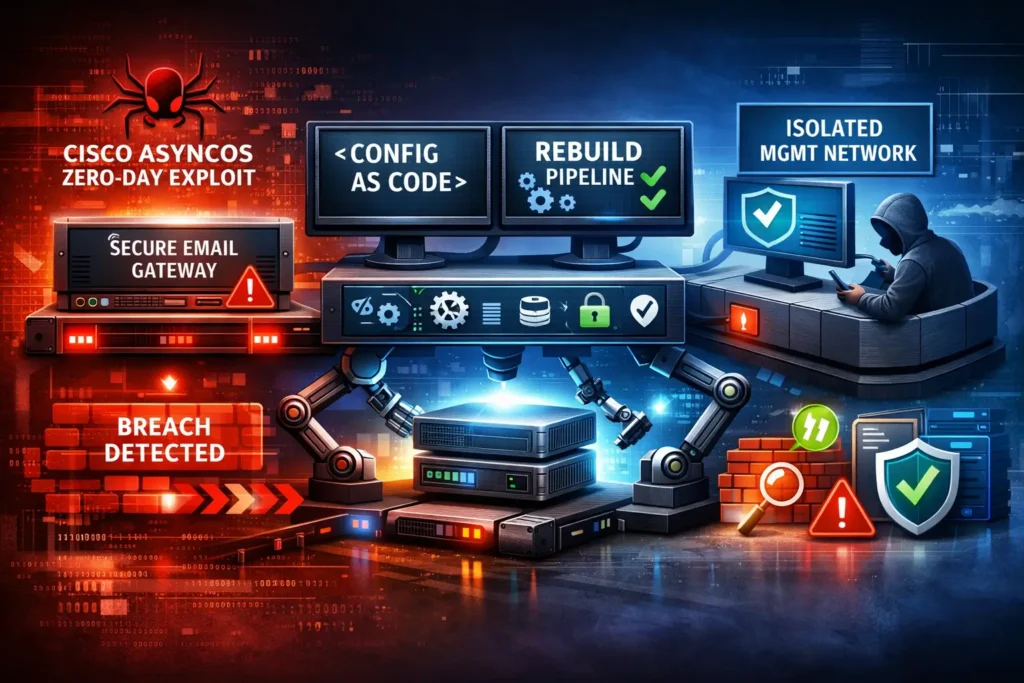
Cisco Secure Email Zero-Day Reality: When an email security appliance is actively exploited, you must assume persistence and prioritize isolation + clean restoration. This post gives engineering leaders a practical “appliance as immutable infrastructure” playbook: versioned configs, repeatable rebuilds, and a monitored management plane—so the next Cisco AsyncOS zero-day doesn’t turn into a multi-week incident.
If your Secure Email Gateway (SEG) or Secure Email & Web Manager sits on the edge of your enterprise email traffic, treat it like production infrastructure—not a “set-and-forget box.” In a Cisco AsyncOS zero-day window, the winner is the team that can rebuild safely, fast, and with evidence.
New: GhostPoster malware defense blueprint — If you’re tightening browser security for engineers, read our practical guide on building a Firefox extension allowlist, collecting the right telemetry, and responding fast to malicious add-ons: https://www.cybersrely.com/ghostposter-malware-firefox-extension-allowlist/
Why email gateways are high-value edge targets (and why zero-days change ops)
Email security appliances are premium targets because they:
- sit on a trust boundary (internet ↔ enterprise),
- parse hostile content all day,
- often expose web interfaces (quarantine/portal/admin),
- integrate with identity (LDAP/SSO), mail routing, policies, and logging.
When a Cisco AsyncOS zero-day is exploited, operations must shift:
- Assume persistence is possible (even if you “blocked it now”).
- Prioritize isolation over “wait for the patch.”
- Plan for clean rebuild as the recovery baseline.
This is why appliance rebuild as code (immutable infrastructure security) is such a powerful pattern for mail gateway incident response.
1) Exposure triage: find what’s reachable and isolate fast
In the first hour, focus on what can be hit from the internet:
- quarantine/portal UI endpoints,
- admin UI endpoints,
- any “helpful” management services exposed outside a dedicated management network.
Quick external port inventory (safe, defensive scoping)
# Replace targets/CIDRs with your own inventory
nmap -sS -sV -Pn --open -p 1-65535 -iL seg_targets.txt -oX out/seg_ports.xml

# Turn XML into a quick report (Markdown table)
python3 scripts/ports_report.py out/seg_ports.xml > out/seg_ports.md
# scripts/ports_report.py
import sys
import xml.etree.ElementTree as ET
tree = ET.parse(sys.argv[1])
root = tree.getroot()
print("| host | port | service | product |")
print("|---|---:|---|---|")
for host in root.findall("host"):
addr = host.find("address").get("addr")
ports = host.find("ports")
if ports is None:
continue
for p in ports.findall("port"):
state = p.find("state").get("state")
if state != "open":
continue
svc = p.find("service")
name = svc.get("name", "") if svc is not None else ""
product = svc.get("product", "") if svc is not None else ""
portid = p.get("portid")
print(f"| {addr} | {portid} | {name} | {product} |")Minimum viable isolation (fast segmentation moves)
- Block internet access to quarantine/portal endpoints unless strictly required.
- Ensure the management interface is only reachable from a jump host/VPN CIDR on a dedicated management network.
- If compromise is suspected: isolate the appliance at the network layer (no inbound/outbound) except what’s needed to export evidence.
“Split lanes” firewall/Security Group example (Infrastructure as Code)
Concept: mail plane ≠ management plane.
# terraform/seg_security.tf (AWS example; same concept for any firewall/ACL)
resource "aws_security_group" "seg_mgmt" {
  name   = "seg-mgmt"
  vpc_id = var.vpc_id

  # Management restricted to VPN/jumpbox CIDR
  ingress {
    from_port   = 22
    to_port     = 22
    protocol    = "tcp"
    cidr_blocks = var.mgmt_cidrs
  }

  ingress {
    from_port   = 443
    to_port     = 443
    protocol    = "tcp"
    cidr_blocks = var.mgmt_cidrs
  }

  egress {
    from_port   = 0
    to_port     = 0
    protocol    = "-1"
    cidr_blocks = ["0.0.0.0/0"]
  }
}

resource "aws_security_group" "seg_mail" {
  name   = "seg-mail"
  vpc_id = var.vpc_id

  # Only mail flows (align to your mail architecture)
  ingress { from_port = 25  to_port = 25  protocol = "tcp" cidr_blocks = ["0.0.0.0/0"] }   # SMTP
  ingress { from_port = 587 to_port = 587 protocol = "tcp" cidr_blocks = ["0.0.0.0/0"] }   # Submission (optional)
  ingress { from_port = 465 to_port = 465 protocol = "tcp" cidr_blocks = ["0.0.0.0/0"] }   # SMTPS (optional)

  egress  { from_port = 0 to_port = 0 protocol = "-1" cidr_blocks = ["0.0.0.0/0"] }
}
2) Immutable rebuild pipeline: make rebuilds boring with “config as code”
Your goal is a routine, repeatable rebuild:
- wipe/replace,
- restore only what you can prove is clean,
- validate exposure controls automatically.
Reference repo layout (ship this pattern)
seg-rebuild/
├── config/
│   ├── asyncos_export.xml        # exported config (sanitized)
│   ├── config.manifest.yaml      # expected exposure + required controls
│   └── overrides/                # env-specific deltas
├── policy/
│   ├── seg.rego                  # OPA rules that prevent unsafe exposure
│   └── logging.rego
├── infra/
│   ├── terraform/                # network + VM/appliance deployment
│   └── ansible/                  # apply config, validate health/logging
├── scripts/
│   ├── sanitize_config.py
│   ├── build_evidence_pack.py
│   └── drift_check.py
└── .github/workflows/
    └── rebuild.yml
Sanitize exported config before committing
Store secrets in a secrets manager; keep the export in git sanitized.
# scripts/sanitize_config.py
import re, sys, pathlib

p = pathlib.Path(sys.argv[1])
data = p.read_text(encoding="utf-8", errors="ignore")

rules = [
  (r"(<Password>).*?(</Password>)", r"\1REDACTED\2"),
  (r"(<SharedSecret>).*?(</SharedSecret>)", r"\1REDACTED\2"),
  (r"(<ApiKey>).*?(</ApiKey>)", r"\1REDACTED\2"),
]

for pat, repl in rules:
    data = re.sub(pat, repl, data, flags=re.DOTALL | re.IGNORECASE)

p.with_suffix(".sanitized.xml").write_text(data, encoding="utf-8")
print(f"OK: wrote {p.with_suffix('.sanitized.xml')}")
3) Hardening patterns that survive Cisco AsyncOS zero-days
This is where “Secure Email Gateway hardening” becomes structural:
- Split interfaces: mail handling vs management (separate VLAN/subnet + separate firewall policy).
- Admin access: MFA/SSO where supported, IP allowlists, jump host only, no direct admin from endpoints.
- Quarantine/portal: treat as internet web surface; disable if not required; otherwise protect heavily.
- Logging baselines: remote syslog + audit/config change logs forwarded off-box.
Drift detection (baseline vs running export)
# scripts/drift_check.py
import hashlib, sys, pathlib

def sha256(path):
    h = hashlib.sha256()
    with open(path, "rb") as f:
        for chunk in iter(lambda: f.read(8192), b""):
            h.update(chunk)
    return h.hexdigest()

expected = pathlib.Path("config/asyncos_export.xml.sanitized.xml")
running  = pathlib.Path("runtime/current_export.xml")  # pulled during check

if sha256(expected) != sha256(running):
    print("DRIFT DETECTED: running export does not match repo baseline.")
    sys.exit(2)

print("OK: no drift detected.")
4) Policy-as-code gates: block “dangerous exposure” by default
During a Cisco AsyncOS zero-day, fail builds if quarantine/management becomes publicly reachable.
# policy/seg.rego
package seg

deny[msg] {
  input.exposure.quarantine_internet_accessible == true
  msg := "Quarantine/portal must not be internet-accessible during a Cisco AsyncOS zero-day window."
}

deny[msg] {
  input.mgmt.cidr == "0.0.0.0/0"
  msg := "Management plane cannot be open to the internet."
}

deny[msg] {
  not input.logging.remote_syslog.enabled
  msg := "Remote syslog must be enabled for rebuild evidence and detection."
}
CI pipeline example (GitHub Actions)
# .github/workflows/rebuild.yml
name: seg-rebuild
on:
  workflow_dispatch:
  pull_request:
    branches: [ "main" ]

jobs:
  validate:
    runs-on: ubuntu-latest
    steps:
      - uses: actions/checkout@v4
      - name: Install OPA
        run: |
          curl -L -o opa https://openpolicyagent.org/downloads/latest/opa_linux_amd64
          chmod +x opa && sudo mv opa /usr/local/bin/opa
      - name: Validate exposure model against policy
        run: |
          opa eval -i config/config.manifest.yaml -d policy/seg.rego "data.seg.deny"
      - name: Build evidence pack
        run: python3 scripts/build_evidence_pack.py
5) Detection: what to alert on during a Cisco AsyncOS zero-day
Alert on signals that indicate:
- unexpected admin actions,
- persistence attempts,
- tunnels / unusual outbound,
- log tampering or log gaps.
High-signal detections to baseline
- new admin accounts/privilege changes/config commits outside change windows
- logins from new IPs/regions
- long-lived outbound connections to unapproved destinations
- sudden stop in syslog forwarding
Example Splunk SPL (admin actions + suspicious outbound)
index=network (src_host="seg*" OR dest_host="seg*")
| stats count min(_time) as first_seen max(_time) as last_seen values(dest_ip) as dest values(dest_port) as ports by src_host, user, action
| where action IN ("login","create_user","grant_role","commit_config") OR mvcount(dest)>10
Example Elastic/KQL (unexpected admin activity)
event.dataset : ("seg.audit" or "seg.auth") and
(event.action : ("login" or "user_add" or "role_change" or "config_commit")) and
not source.ip : (10.0.0.0/8 or 192.168.0.0/16)
6) Recovery evidence: rebuild proof for audits and post-incident reports
Your post-incident narrative should be automatic:
- what was rebuilt,
- when,
- from which known-good config,
- with cryptographic hashes.
Evidence pack builder (hashes + commit ID + artifacts list)
# scripts/build_evidence_pack.py
import hashlib, json, os, subprocess, time, pathlib, zipfile

OUT = pathlib.Path("out")
OUT.mkdir(exist_ok=True)
stamp = time.strftime("%Y%m%d-%H%M%S")

def sha256(path):
    h = hashlib.sha256()
    with open(path, "rb") as f:
        for chunk in iter(lambda: f.read(8192), b""):
            h.update(chunk)
    return h.hexdigest()

def git(cmd):
    return subprocess.check_output(["git"] + cmd, text=True).strip()

files = [
    "config/asyncos_export.xml.sanitized.xml",
    "config/config.manifest.yaml",
    "policy/seg.rego",
    ".github/workflows/rebuild.yml",
]

manifest = {
  "created_at_utc": time.strftime("%Y-%m-%dT%H:%M:%SZ", time.gmtime()),
  "git_commit": git(["rev-parse","HEAD"]),
  "git_branch": git(["rev-parse","--abbrev-ref","HEAD"]),
  "files": {f: sha256(f) for f in files if os.path.exists(f)},
}

manifest_path = OUT / f"seg_evidence_{stamp}.json"
manifest_path.write_text(json.dumps(manifest, indent=2))

zip_path = OUT / f"seg_evidence_{stamp}.zip"
with zipfile.ZipFile(zip_path, "w", compression=zipfile.ZIP_DEFLATED) as z:
    z.write(manifest_path, arcname=manifest_path.name)
    for f in files:
        if os.path.exists(f):
            z.write(f, arcname=f)

print(f"OK: {zip_path}")
7) Long-term prevention: continuous attack-surface checks + mitigation SLAs
Turn “zero-day chaos” into routine engineering hygiene:
- weekly external exposure checks (ports + HTTP paths),
- PR-only config changes,
- time-boxed mitigation SLAs for internet-facing management/quarantine,
- quarterly rebuild drills.
Weekly exposure diff (simple pattern)
# scripts/exposure_diff.py
import json, sys, pathlib
from deepdiff import DeepDiff

old = json.loads(pathlib.Path(sys.argv[1]).read_text())
new = json.loads(pathlib.Path(sys.argv[2]).read_text())

diff = DeepDiff(old, new, ignore_order=True)
print(diff.to_json(indent=2))
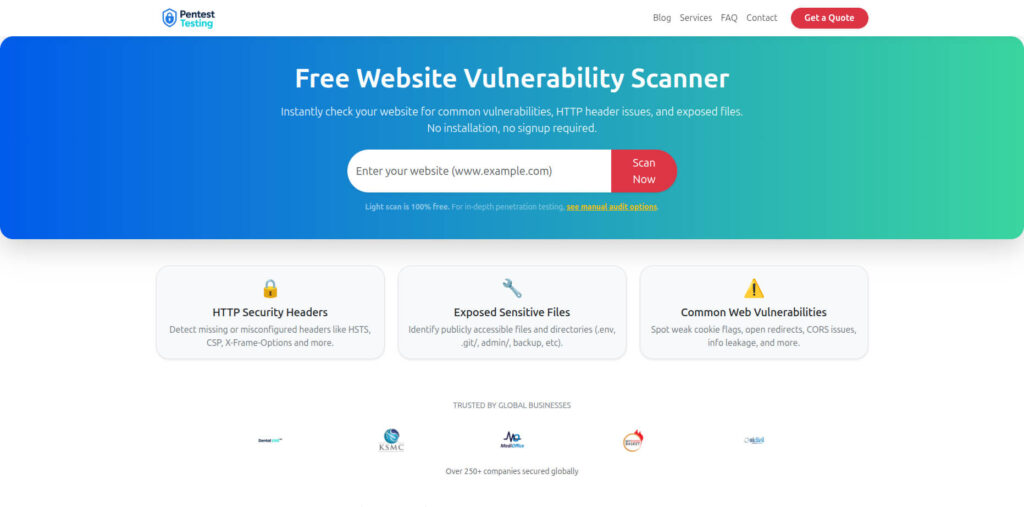
Free Website Vulnerability Scanner tool page
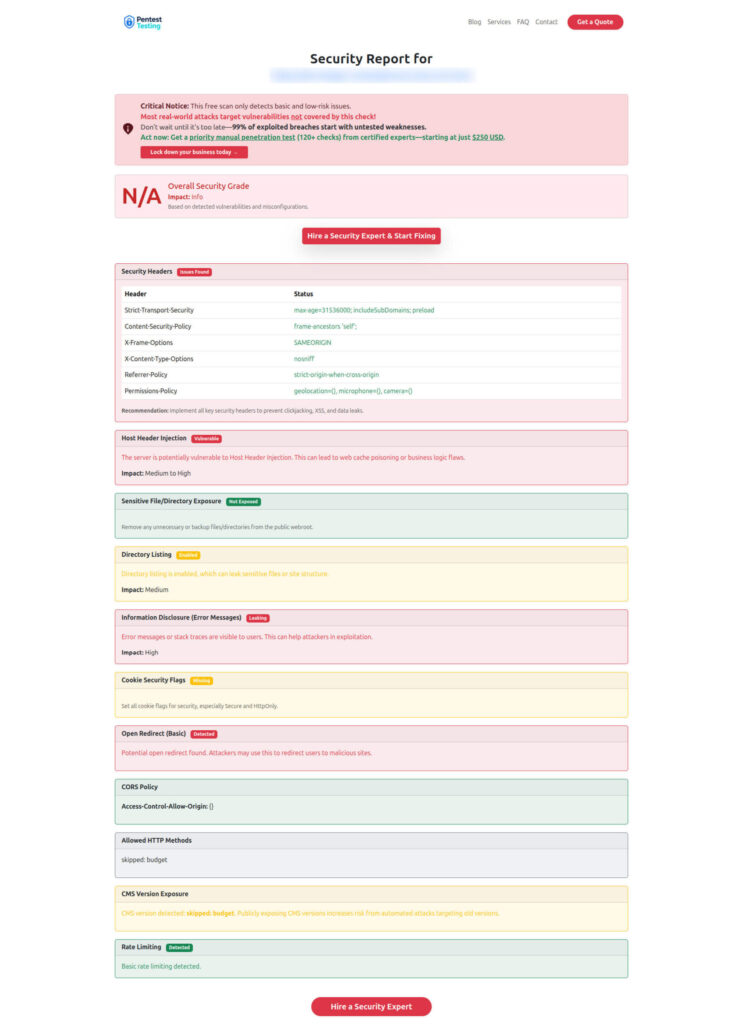
Sample report to check Website Vulnerability
Where we can help (services + engineering support)
For risk assessment and hands-on remediation support:
- https://www.pentesttesting.com/risk-assessment-services/
- https://www.pentesttesting.com/remediation-services/
Free starter assessment:
Recommended next reads (recent posts)
- Secrets as Code patterns: https://www.cybersrely.com/secrets-as-code-patterns/
- Security chaos experiments for CI/CD: https://www.cybersrely.com/security-chaos-experiments-for-ci-cd/
- Non-human identity security controls: https://www.cybersrely.com/non-human-identity-security-controls/
- CISA KEV remediation sprint: https://www.pentesttesting.com/cisa-kev-remediation-sprint-in-30-days/
- React2Shell fix playbook: https://www.pentesttesting.com/react2shell-cve-2025-55182-fix-steps/
🔐 Frequently Asked Questions (FAQs)
Find answers to commonly asked questions about Cisco AsyncOS Zero-Day Rebuild Patterns.