Secrets as Code: 7 Proven Patterns for Rotation, JIT Access & Audit-Ready Logs
On Cyber Rely, we focus on patterns engineering leaders can actually ship—not just policy decks.
If you’re already wiring CI/CD, DORA, or supply-chain controls into pipelines, you’ve probably noticed one big gap: who had access to which secret, when, and under what guardrails is rarely captured as code + evidence.
That’s what Secrets as Code solves: treating API keys, DB creds, machine tokens, and KMS keys like you treat infra and policy—as versioned, reviewable, testable artifacts that generate audit-ready logs by default.
In this guide, we’ll cover:
- Why Secrets as Code is the missing layer between IAM and CI/CD
- 7 patterns you can ship this quarter (with runnable code examples)
- How they map to SOC 2, ISO 27001, PCI DSS 4.0.1, NIST SSDF
- When to pull in formal risk & remediation sprints with Pentest Testing Corp
- How to use our Free Website Vulnerability Scanner as an external signal
Why “Secrets as Code” Is the Missing Layer
Recent incidents showed the same root cause in different clothing:
- Long-lived CI tokens copied into multiple pipelines
- Cloud keys reused across environments and teams
- Debug tokens left in logs or sample configs
- Secrets managers deployed—but not wired into SDLC, change control, or logging
Every postmortem ended with audit questions like:
- Who could use this token?
- When was it last rotated?
- Which services depended on it?
- What evidence do we have that rotation and access control were enforced?
Secrets as Code answers these by:
- Centralizing secrets in backends with clear namespaces (apps, envs, tenants)
- Issuing short-lived, just-in-time secrets to CI jobs and services
- Defining rotation-as-code with blast-radius tests
- Using policy-as-code to describe “which service can talk to which DB/queue”
- Emitting structured logs that map directly to control families
Think of it as the layer that connects “secure by design” in your pipelines with “audit-ready by default” for your compliance teams. Cyber Rely’s existing CI/CD compliance and supply-chain posts already push you in this direction—Secrets as Code is the natural extension for credential lifecycle.
For a deeper, hands-on view of how to actually run and measure these drills, check out our dedicated guide on security chaos experiments for CI/CD, where we walk through six practical experiments engineering leaders can run this quarter.
7 Secrets as Code Patterns You Can Ship This Quarter
1) Central Secret Backends with Namespaced Apps & Projects
First, get away from “YAML files full of secrets” and “shared CI variables” toward centralized secret engines (Vault, KMS/SM, SSM, Secrets Manager, etc.) with namespaces per app, environment, and project.
Goal
- Every secret belongs to:
team/appenvironment(dev/stage/prod)purpose(db, api, token)
- Access via identity (OIDC, workload ID), not static credentials.
Example: Namespaced secrets in Vault (Kubernetes app)
# vault.hcl (simplified)
path "secret/data/payments/prod/*" {
  capabilities = ["read"]
}

# K8s service account for payments-api
path "auth/kubernetes/role/payments-api" {
  capabilities = ["update"]
}
Kubernetes annotation to bind app → Vault role
apiVersion: v1
kind: ServiceAccount
metadata:
  name: payments-api
  namespace: prod
  annotations:
    vault.hashicorp.com/role: "payments-api"
App-level fetch (Node.js example)
import fetch from "node-fetch";

async function getDbCreds() {
  const token = process.env.VAULT_TOKEN; // from sidecar / JWT auth
  const res = await fetch(
    "https://vault.internal/v1/secret/data/payments/prod/db",
    { headers: { "X-Vault-Token": token } }
  );
  const json = await res.json();
  return json.data.data; // { username, password }
}
Controls it supports
- SOC 2: CC6.x (access controls), CC7.x (change management)
- ISO 27001: A.5 (policies), A.8 (access control), A.10 (cryptography)
- PCI DSS 4.0.1: central credential store for CDE access (Req. 7, 8)
2) Just-in-Time Secrets for CI/CD Jobs
Instead of long-lived CI tokens, issue short-lived, just-in-time credentials scoped to a single pipeline run or environment.
Goal
- CI job identity (OIDC, workload identity) → secret backend issues short-lived creds
- Creds valid for minutes, tied to job metadata (repo, branch, environment).
Example: GitHub Actions → AWS STS via OIDC
name: build-and-deploy
on: [push]

jobs:
  deploy:
    runs-on: ubuntu-latest
    permissions:
      id-token: write
      contents: read
    steps:
      - uses: actions/checkout@v4

      - name: Configure AWS creds JIT
        uses: aws-actions/configure-aws-credentials@v4
        with:
          role-to-assume: arn:aws:iam::123456789012:role/ci-deploy-prod
          aws-region: us-east-1
          role-session-name: ci-${{ github.run_id }}

      - name: Deploy
        run: |
          aws eks update-kubeconfig --name prod-cluster
          kubectl apply -f k8s/
Vault JIT DB creds via CLI
vault write database/creds/payments-prod \
  ttl=15m \
  metadata="repo=${GITHUB_REPOSITORY},run=${GITHUB_RUN_ID}"
Controls
- SOC 2: least privilege, strong access control
- ISO 27001: A.8.2 (user access management)
- PCI DSS: “strong access control” & unique IDs for users/processes (7.x, 8.x)
- NIST SSDF: PO.3, PW.7 (environment hardening & access control)
3) Rotation-as-Code Pipelines (with Blast-Radius Tests)
Rotation fails when it’s ad-hoc and undocumented. Treat rotation as a repeatable pipeline with pre-checks, rollout steps, and verification.
Goal
- Secrets have rotation frequency, owner, and playbook defined as code
- Rotation runs via CI (manual or scheduled)
- Each rotation emits machine-readable events for audits.
Example: GitHub Actions scheduled rotation for Postgres creds
name: rotate-postgres-secrets
on:
  schedule:
    - cron: "0 2 * * 0"  # every Sunday 02:00 UTC
  workflow_dispatch:

jobs:
  rotate:
    runs-on: ubuntu-latest
    steps:
      - uses: actions/checkout@v4

      - name: Generate new password
        id: gen
        run: |
          PWD=$(openssl rand -base64 32)
          echo "password=$PWD" >> "$GITHUB_OUTPUT"

      - name: Update DB user
        env:
          PGPASSWORD: ${{ secrets.PG_ADMIN_PASSWORD }}
        run: |
          psql "$PG_CONN" \
            -c "ALTER USER app_user WITH PASSWORD '${{ steps.gen.outputs.password }}';"

      - name: Update secrets backend
        run: |
          vault kv put secret/data/payments/prod/db \
            username=app_user \
            password='${{ steps.gen.outputs.password }}' \
            version_ts="$(date -Iseconds)" \
            rotated_by="${{ github.actor }}" \
            rotation_run="${{ github.run_id }}"

      - name: Run smoke tests
        run: npm test -- --group=db-connectivity
Controls
- SOC 2 / ISO 27001: key management & change control
- PCI DSS 4.0.1: regular credential changes as part of remediation patterns
- NIST SSDF: RV.1–RV.3 (managing vulnerabilities and weaknesses)
4) Git Hooks & CI Checks to Block Hard-Coded Secrets
Secrets as Code still fails if developers accidentally push secrets to Git. You need pre-commit and CI gates to block them.
Goal
- Local pre-commit hook catches obvious secrets
- CI runs deeper scans (e.g., regex+entropy) and fails builds on hits
- Logs link detections to repo, file, and commit.
Example: .pre-commit-config.yaml
repos:
  - repo: https://github.com/zricethezav/gitleaks
    rev: v8.18.0
    hooks:
      - id: gitleaks
        args: ["--redact"]
CI enforcement
- name: Scan for hard-coded secrets
  run: |
    gitleaks detect \
      --source . \
      --no-banner \
      --report-format sarif \
      --report-path gitleaks.sarif
If a secret is found:
- CI job fails
- Issue is opened with:
- suspected secret type
- file & line
- suggestion to move it into the secret backend and rotate immediately
Controls
- SOC 2: change management, code review
- ISO 27001: secure development practices
- NIST SSDF: PW.6, PW.8 (preventing introduction of vulnerabilities in code)
5) Tie Secrets Usage into Change-Management Evidence
Your auditors don’t just care that secrets exist—they care how changes to secrets relate to changes to systems.
Goal
- Each deployment references:
- secret name
- secret version (or rotation timestamp)
- Logs capture: “deployment X used secret version Y”.
Example: annotating K8s Deployments with secret version
apiVersion: apps/v1
kind: Deployment
metadata:
  name: payments-api
  labels:
    app: payments-api
  annotations:
    secrets.version/payments-db: "2025-11-20T02:00:00Z"
spec:
  template:
    metadata:
      annotations:
        secrets.version/payments-db: "2025-11-20T02:00:00Z"
    spec:
      containers:
        - name: app
          image: registry/payments-api:${GIT_SHA}
Example: logging secret usage (no secret values)
{
  "ts": "2025-11-20T02:15:32Z",
  "service": "payments-api",
  "env": "prod",
  "secret_name": "payments-db",
  "secret_version_ts": "2025-11-20T02:00:00Z",
  "deploy_id": "deploy-12345",
  "actor": "github-actions[bot]"
}
Controls
- SOC 2: maps directly to change management and evidence
- ISO 27001: supports A.12 (operations) and A.5 (policies)
- NIST SSDF: GV.3, PS.3 (governance and traceability)
6) Policy-as-Code: Which Service Can Talk to Which DB/Queue
Static IP allow-lists don’t survive modern architectures. Instead, use identity and tags to express allowed relationships between services and data stores.
Goal
- Policies written as code (Rego, Cedar, custom DSL)
- Inputs:
service identity,resource tags,environment - Evaluated in:
- secret backend (issue or deny credentials)
- API gateways / sidecars (enforce data access)
Example: Rego-style policy (conceptual)
package secrets.authz

default allow = false

allow {
  input.service.name == "payments-api"
  input.service.env == "prod"
  input.secret.name == "payments-db"
  input.secret.tags["pci_scope"] == "cde"
  input.service.tags["pci_role"] == "card-processor"
}
Evaluation input
{
  "service": {
    "name": "payments-api",
    "env": "prod",
    "tags": { "pci_role": "card-processor" }
  },
  "secret": {
    "name": "payments-db",
    "tags": { "pci_scope": "cde" }
  }
}
If allow is true, the secrets backend issues credentials; otherwise it denies and logs the attempt.
Controls
- PCI DSS 4.0.1: CDE segmentation, least privilege, codified as policy-as-code
- SOC 2/ISO 27001: robust access control models
- NIST SSDF: PO.1 (governance), PW.7 (access control)
7) Logging & Reporting Patterns for Audit-Ready Views
Finally, Secrets as Code doesn’t land unless risk, compliance, and auditors can see clean, queryable views.
Goal
- Normalize logs for:
- secret creation
- rotation
- access (issued tokens/creds)
- failures & denials
- Build views that answer:
- “Who had access to secret X between dates Y and Z?”
- “Which prod services used secrets with missing rotation in the last 30 days?”
Example: log schema (pseudo-SQL)
CREATE TABLE secret_events (
  ts timestamptz,
  event_type text,           -- CREATED, ROTATED, ACCESSED, DENIED
  secret_name text,
  secret_scope jsonb,        -- {"team":"payments","env":"prod","purpose":"db"}
  actor_type text,           -- USER, SERVICE, CI_JOB
  actor_id text,             -- user id, service id, pipeline id
  rotation_run text,         -- CI run id, if applicable
  metadata jsonb
);
Query: who accessed payments-db in October?
SELECT actor_type, actor_id, ts
FROM secret_events
WHERE secret_name = 'payments-db'
  AND event_type = 'ACCESSED'
  AND ts >= '2025-10-01'::timestamptz
  AND ts <  '2025-11-01'::timestamptz;
Controls
- SOC 2: monitoring, logging, incident investigation
- ISO 27001: A.12.4 (logging)
- NIST SSDF: RV.2, RV.3 (detecting and responding to issues)
How This Helps with SOC 2, ISO 27001, PCI DSS & NIST SSDF
You don’t need new frameworks; Secrets as Code simply makes existing controls provable:
- Access Control (SOC 2 CC6, ISO 27001 A.8, PCI 7–8)
- Namespaced secrets, JIT tokens, policy-as-code.
- Key & Credential Management (ISO 27001 A.10, PCI cryptographic controls)
- Central backends, rotation-as-code, logged access.
- Secure SDLC/SSDF (NIST SSDF PW., RV.)
- Secret scanning in code, CI gates, evidence from pipelines.
- Audit Evidence & Reporting
- Change-management mapping: “this deployment used this secret version.”
For deeper mapping to specific SOC 2 trust principles and ISO 27001 Annex A controls, you can reuse the same patterns we use to map CI/CD findings to SOC 2 & ISO 27001 in earlier Cyber Rely content.
When to Call in Formal Risk & Remediation Support
Secrets as Code gets you far, but some scenarios call for formal assurance:
- PCI DSS 4.0.1 or payment environments with shared DBs and mixed workloads
- Complex multi-cloud, multi-tenant architectures (e.g., SaaS platforms)
- Regimes like DORA, NIS2, SSDF 1.1, EU AI Act, where auditors want traceability from law → control → evidence
That’s where Pentest Testing Corp plugs in:
- Risk Assessment Services – have a formal team turn these findings into a risk register auditors recognize, with scoped gaps and a prioritized roadmap.
- Remediation Services – when you’re untangling legacy keys across repos and clouds, treat it as a focused remediation sprint rather than scattered tickets.
- Compliance sprints – align Secrets as Code patterns to SOC 2, ISO 27001, PCI DSS, NIST SSDF, DORA and generate the artifacts your assessors expect.
Quick External Reality Check: Free Website Vulnerability Scanner
While Secrets as Code hardens internals, you still need an outside-in view of what’s exposed to the internet.
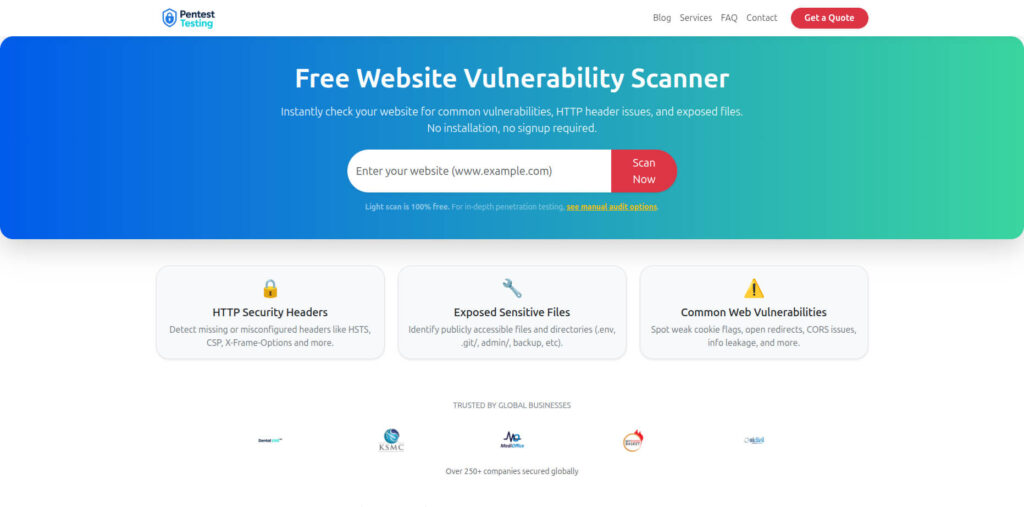
Use our Free Website Vulnerability Scanner, powered by Pentest Testing Corp, as a fast external signal to seed your backlog with real issues—an approach we also use in our DORA and PCI DSS 4.0.1 playbooks.
- Free Website Vulnerability Scanner
👉 https://free.pentesttesting.com/
Screenshot of our Website Vulnerability Scanner landing page
Sample assessment report screenshot to check Website Vulnerability
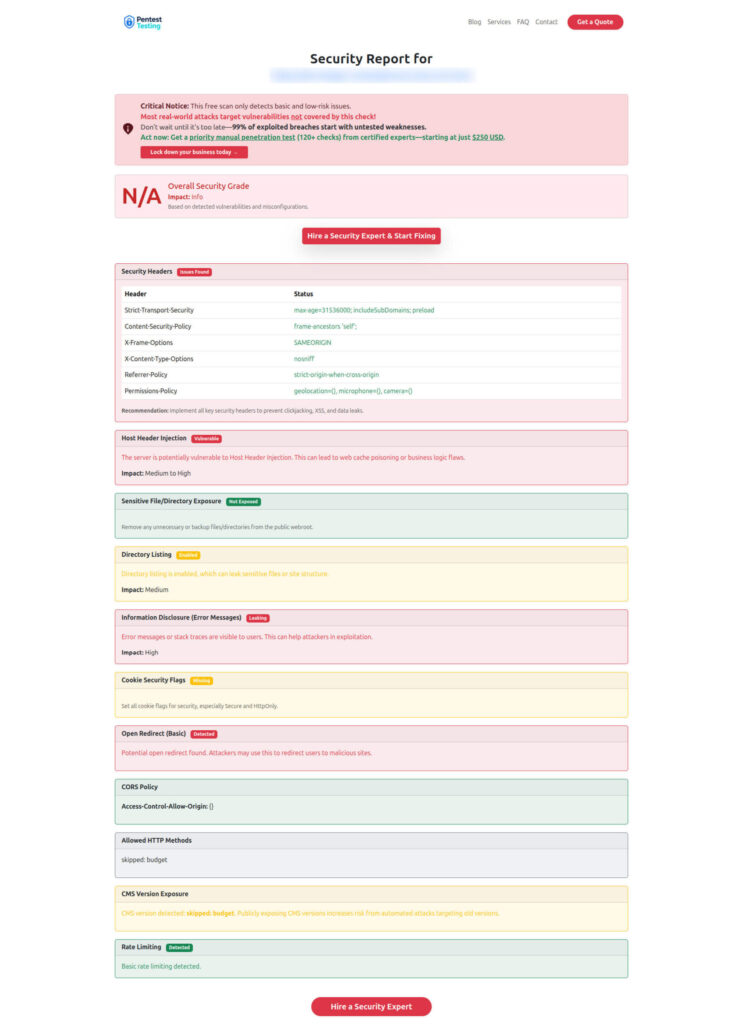
Use the scanner as:
- A pre-commitment check before big launches
- An external guardrail alongside Secrets as Code, SLSA, and supply-chain controls
- A concrete way to show auditors: “we continuously scan our attack surface and link findings into our formal risk register.”
Where This Fits with Other Cyber Rely Guides
If you’re rolling out Secrets as Code, your teams will benefit from these related Cyber Rely posts:
- “7 Powerful Tactics for Embedded Compliance in CI/CD” – turning CI/CD into a control surface that generates evidence.
- “5 Proven Ways to Map CI/CD Findings to SOC 2 and ISO 27001” – shows exactly how to translate technical findings into auditor-ready mappings.
- “7 Proven Software Supply Chain Security Tactics” – embedding SBOM, VEX, and SLSA to protect builds from dependency and registry attacks.
- “npm supply chain attack 2025: ‘Shai-Hulud’ CI fixes” – developer-first playbook for active npm attacks targeting CI secrets.
- “7 Proven Steps: SLSA 1.1 Implementation in CI/CD” and SSDF 1.1 attestation guides – ship signed artifacts, provenance, and evidence that pairs neatly with Secrets as Code for creds.
Together, these posts help your org move from “we store secrets somewhere safe” to “we can prove, with code and logs, who had access to what, when, and why.”
🔐 Frequently Asked Questions (FAQs)
Find answers to commonly asked questions about Secrets as Code for Engineering Leaders.